
Masai Mara National Reserve: The Complete Safari Guide
Quick answer
A Masai Mara safari explores Kenya's most famous reserve, roughly 1,500 square kilometres of open grassland in the country's south-west. It is renowned for exceptional lion, cheetah and leopard viewing year-round, and for the Great Migration river crossings that arrive from Tanzania's Serengeti between roughly July and October each year.
A Masai Mara safari is, for most travellers, the single most productive few days of wildlife viewing available anywhere in Africa. The reserve covers roughly 1,500 square kilometres of rolling grassland, riverine forest and scattered acacia in south-western Kenya, sitting directly against the Tanzanian border where it becomes the Serengeti. What makes it exceptional is not one thing but the combination: an unusually high density of resident predators, terrain open enough that you can actually watch them hunt, and — for a few months each year — the arrival of the Great Migration and its river crossings. You can have a superb Mara safari in any month; you simply have different experiences depending on when you come.
Why the Masai Mara earns its reputation
Plenty of parks hold big cats. The Mara is different because the landscape lets you see them. The plains here are broad and gently undulating, broken by seasonal watercourses and stands of balanites and croton scrub, with the Mara and Talek rivers cutting through the middle in belts of dense green forest. There is very little thick bush to swallow an animal up. A lion pride resting on an open slope is visible from a long way off, and a cheetah using a termite mound as a lookout is one of the most reliably photographable sights in East Africa.
The other half of the story is the ecosystem's scale. The national reserve itself is only the core. Around its northern and eastern edges lies a ring of community-owned conservancies — Maasai landowners leasing their grazing land to a small number of camps in exchange for a steady income — which effectively doubles the protected area and gives wildlife room to move. Combined with the Serengeti to the south, this is one of the last places on earth where a genuinely large mammal migration still functions across an unfenced landscape.
The wildlife you can expect to see
The Mara delivers on the Big Five, though with one honest caveat: rhino are present but scarce and closely protected, and seeing one is a matter of luck rather than planning. Everything else is a realistic expectation across a three- or four-night stay.
- Lion — the Mara supports some of the best-studied and most habituated prides in Africa. Sightings are close to guaranteed, often multiple prides in a single stay.
- Cheetah — the open grassland suits them, and daytime hunts are genuinely possible to witness rather than merely hoped for.
- Leopard — most often found along the wooded margins of the Mara and Talek rivers, usually in early morning or late afternoon.
- Elephant and buffalo — both resident in good numbers, with elephant family groups moving between the plains and the riverine forest.
- Plains game — topi, Coke's hartebeest, eland, Thomson's and Grant's gazelle, impala, zebra, warthog and giraffe are everywhere, and they are what sustain the predator density.
- Hippo and crocodile — permanent residents of the Mara River, and the reason the migration crossings are as dramatic as they are.
- Birds — several hundred species, including secretary birds, ground hornbills, a full cast of raptors, and European migrants that swell the numbers from around November through April.
What surprises many first-time visitors is how much happens outside the headline sightings: black-backed jackals working a kill, a serval hunting rodents at dusk, spotted hyena clans defending a carcass at dawn. Good guiding turns those into the moments you remember.
The Great Migration, and what it actually looks like
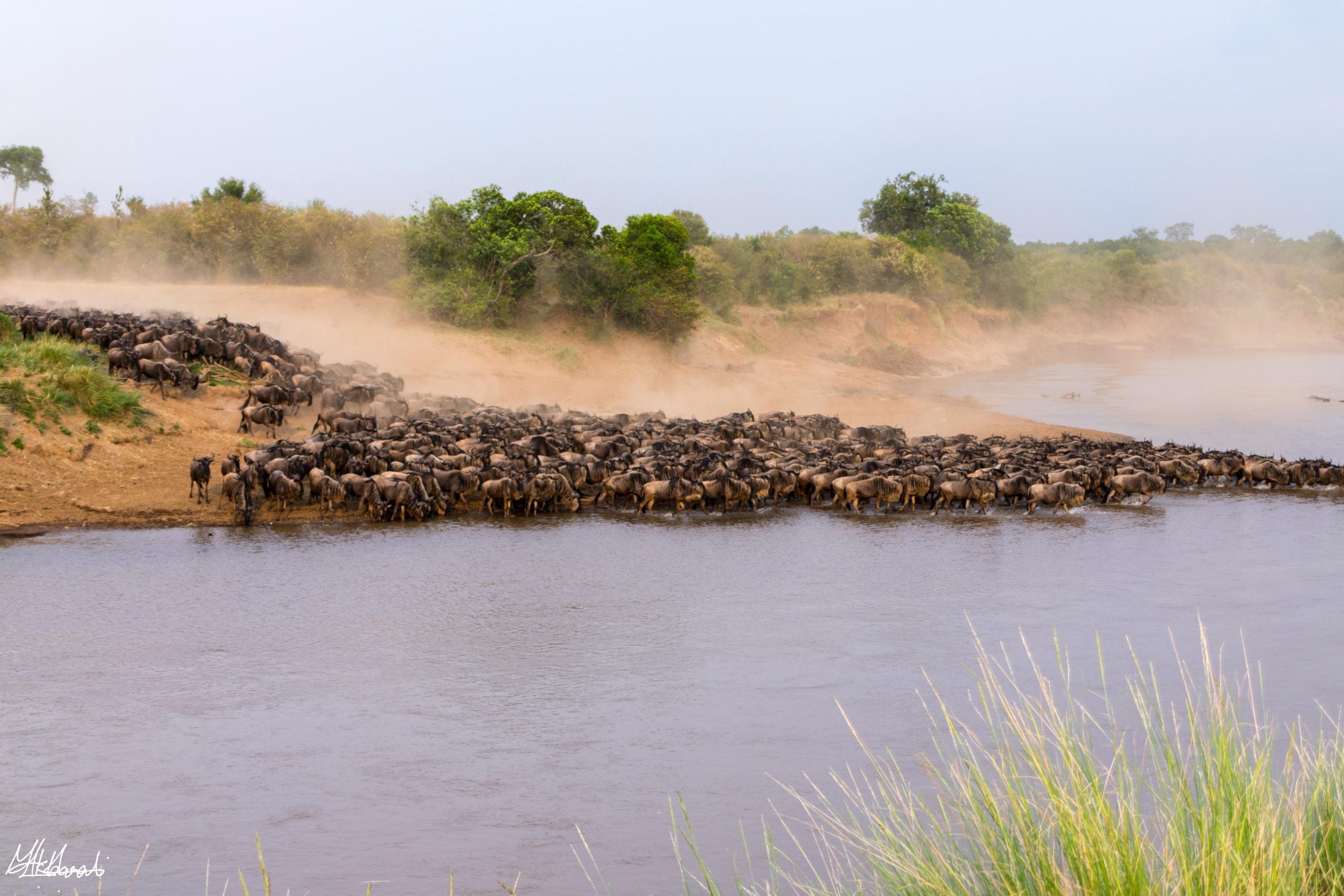
The Great Migration is a year-round, roughly circular movement of well over a million wildebeest, plus large numbers of zebra and gazelle, following rainfall and fresh grazing around the Serengeti–Mara ecosystem. The herds spend most of the year in Tanzania. They typically push north into the Mara from around July, spread across the northern plains through August and September, and drift back south from around October as the short rains begin.
The river crossings — the images everyone has seen — happen when herds meet the Mara River and eventually commit to it. They are unpredictable by nature. Animals may mass on a bank for hours and then turn away; a crossing may erupt with no warning at a point nobody was watching. Honest planning means booking a location with good river access during the crossing window, allowing several days rather than one, and treating the crossing as a possibility rather than a promise. Guests who come with that mindset almost always leave happy, because the sheer density of animals on the plains during migration months is spectacular in its own right.
Best time to visit, season by season
- July to October — peak season. Dry, cool mornings, thinning grass and the migration in residence. The most reliable window for crossings, and also the busiest and most expensive. Book well ahead.
- January to early March — the short dry season. Excellent conditions with far fewer vehicles. Grass is low, predator viewing is superb, and this is quietly one of our favourite times to send travellers.
- March to May — the long rains. April is typically the wettest month. Rain tends to come as heavy afternoon storms rather than all-day drizzle, and the landscape turns brilliantly green. Fewer visitors, softer rates, dramatic skies — but roads can be demanding and some camps close.
- November to December — the short rains. Short showers, green plains, newborn plains game and outstanding birding as migrants arrive. Game viewing remains strong.
Temperatures are moderate year-round thanks to altitude. Days are warm rather than hot; early morning game drives and evenings can be genuinely cold, which catches people out.
Reserve or conservancy? The decision that shapes your safari
This single choice affects your experience more than which camp you pick. The national reserve is publicly managed and open to day visitors and self-drivers, which means the best sightings can attract a crowd of vehicles. It also holds the Mara River crossing points, so it is where you need to be during migration months. Off-road driving is restricted and night drives are not permitted.
The surrounding conservancies work differently. Bed numbers are capped, most limit how many vehicles may attend a sighting, and many permit off-road driving, guided walking safaris and night drives. Wildlife densities are excellent, particularly for big cats. The trade-off is that the migration herds spread into the conservancies less predictably than they gather at the river.
For most travellers we recommend combining the two — a few nights in the reserve during crossing season, a few in a conservancy for the exclusivity, walking and night drives. Conservancy fees are charged per person per night in addition to reserve entry, and we confirm current rates when we quote.
Getting to the Masai Mara
There are two realistic options, and most itineraries use both at different points.
- Flying — light aircraft leave Nairobi's Wilson Airport several times daily for the Mara's network of airstrips, and the hop takes well under an hour. Your camp meets the aircraft and you can be on a game drive within minutes of landing. Baggage is limited to soft bags with a strict weight allowance; we confirm the exact figure for your flight.
- Driving — the road journey from Nairobi takes most of a day, and conditions on the final stretch vary with recent rain. It is more tiring but lets you see the Rift Valley escarpment and works well if you are travelling as a family or continuing overland.
Because the Mara adjoins the Serengeti, it also links neatly to a safari in Tanzania. Travellers regularly combine the two sides of the same ecosystem, either by air via Nairobi or overland through the border — a route our Arusha office handles constantly and can sequence so you follow the herds rather than crossing back over them.
Where to stay: the categories that matter
Rather than name properties that may change hands or rates, it helps to understand the categories we book into:
- Classic luxury tented camps — canvas rooms on raised decks with proper beds, en-suite bathrooms and full service. This is the archetypal Mara stay and the sweet spot for most of our guests.
- Permanent lodges — solid-walled rooms, larger guest numbers, often with pools and family-friendly facilities. Good value and dependable, with less of a wilderness feel.
- Small conservancy camps — often eight to twelve rooms, with exclusive traversing rights, walking and night drives included. The most immersive option.
- Private houses and exclusive-use villas — an entire house with dedicated guide, vehicle and chef. Excellent for families or groups travelling together.
- Mobile and seasonal camps — lighter-footprint camps that move with the season, frequently positioned for the migration.
Odysseys From Africa is a tour operator, not a hotelier: we do not own or run any camp. That independence is the point — we place you in whichever property genuinely suits your travel dates, budget and appetite for remoteness, and we say so plainly when a well-known name is not the right fit for you.
Where the Mara fits in a wider Kenya itinerary
The Mara is a destination, not an itinerary. Three to four nights is the practical minimum; anything shorter and you spend a disproportionate share of your time in transit. Beyond that, the classic Kenyan circuit pairs the Mara's grassland predators with two contrasting landscapes: the Rift Valley lakes for flamingo, rhino and birdlife, and the dust-and-mountain drama of Amboseli in the south for elephants beneath Kilimanjaro. That contrast is what turns a game-viewing trip into a proper journey.
Our Best of Kenya itinerary is built around exactly that progression for travellers who want the fuller picture, while Kenya Explorer suits those with less time who still want the Mara at the heart of the trip. Both are starting points rather than fixed packages — every departure we run is rebuilt around the party travelling.
Practical tips, and who the Mara suits
- Pack layers. Pre-dawn game drives are cold; midday is warm. Neutral colours, a warm fleece and a windproof jacket cover almost everything.
- Bring binoculars — one pair per person, not one shared pair. It is the single upgrade guests thank us for most.
- The Mara is a malaria area. Speak to your doctor about prophylaxis well before you travel.
- Kenya requires an electronic travel authorisation for most visitors; apply online in good time rather than on arrival.
- Park and conservancy fees are charged per person per day and change periodically. We confirm current rates in writing when quoting so there are no surprises.
- Hot-air balloon flights over the plains operate at dawn and are booked separately — worth arranging before arrival in peak season.
- Tipping guides and camp staff is customary; we send clear, non-awkward guidance before departure.
The Mara suits first-time safari travellers who want a high certainty of memorable sightings, photographers who need open light and open terrain, families who benefit from short flights and shorter drives, and returning safari-goers who come specifically for the migration or for the conservancies' walking and night driving. It suits anyone less well if you are chasing solitude in peak season inside the reserve itself — in which case we will steer you towards a conservancy, or towards January and February.
We are a licensed, family-founded operator based in Arusha, and we have spent years working both sides of the Serengeti–Mara border. If you would like a Mara safari built properly around your dates, your pace and what you actually care about seeing, talk to our Arusha-based team. We work by reservation only — no online payment, no automated booking engine. Just a conversation, an honest recommendation, and a written quote with every cost set out clearly.
Frequently asked questions
When is the best time for a Masai Mara safari?
July to October is peak season, when the Great Migration is in the Mara and river crossings are possible. January to early March offers excellent game viewing with far fewer vehicles. The green seasons of March to May and November to December bring lower rates, dramatic skies and superb birding, with resident wildlife still very visible.
Am I guaranteed to see a river crossing?
No, and any operator who guarantees one is not being straight with you. Crossings are unpredictable: herds can gather for hours and turn back, or cross with no warning. Booking a camp with good river access during the July to October window and allowing several days there gives you the strongest realistic chance.
Should I stay in the national reserve or a private conservancy?
The reserve holds the Mara River crossing points and is where you need to be during migration months, but it can get busy and restricts off-road and night driving. Conservancies cap bed numbers, limit vehicles at sightings, and usually permit night drives and walking safaris. Many of our guests combine both.
How many nights should I spend in the Masai Mara?
Three to four nights is the practical minimum. Shorter stays mean a disproportionate share of your time goes on transfers rather than game drives. If you want to combine the reserve with a private conservancy, or you are visiting during the migration, five or six nights lets the destination breathe.
Can I combine the Masai Mara with Tanzania?
Yes. The Mara adjoins Tanzania's Serengeti and forms one ecosystem with it, so combining the two is natural. Travellers usually connect by air via Nairobi or overland through the border. As an Arusha-based operator we handle both sides regularly and sequence the route so you follow the herds rather than backtrack.
Frequently asked questions
- When is the best time for a Masai Mara safari?
- July to October is peak season, when the Great Migration is in the Mara and river crossings are possible. January to early March offers excellent game viewing with far fewer vehicles. The green seasons of March to May and November to December bring lower rates, dramatic skies and superb birding, with resident wildlife still very visible.
- Am I guaranteed to see a river crossing?
- No, and any operator who guarantees one is not being straight with you. Crossings are unpredictable: herds can gather for hours and turn back, or cross with no warning. Booking a camp with good river access during the July to October window and allowing several days there gives you the strongest realistic chance.
- Should I stay in the national reserve or a private conservancy?
- The reserve holds the Mara River crossing points and is where you need to be during migration months, but it can get busy and restricts off-road and night driving. Conservancies cap bed numbers, limit vehicles at sightings, and usually permit night drives and walking safaris. Many of our guests combine both.
- How many nights should I spend in the Masai Mara?
- Three to four nights is the practical minimum. Shorter stays mean a disproportionate share of your time goes on transfers rather than game drives. If you want to combine the reserve with a private conservancy, or you are visiting during the migration, five or six nights lets the destination breathe.
- Can I combine the Masai Mara with Tanzania?
- Yes. The Mara adjoins Tanzania's Serengeti and forms one ecosystem with it, so combining the two is natural. Travellers usually connect by air via Nairobi or overland through the border. As an Arusha-based operator we handle both sides regularly and sequence the route so you follow the herds rather than backtrack.