
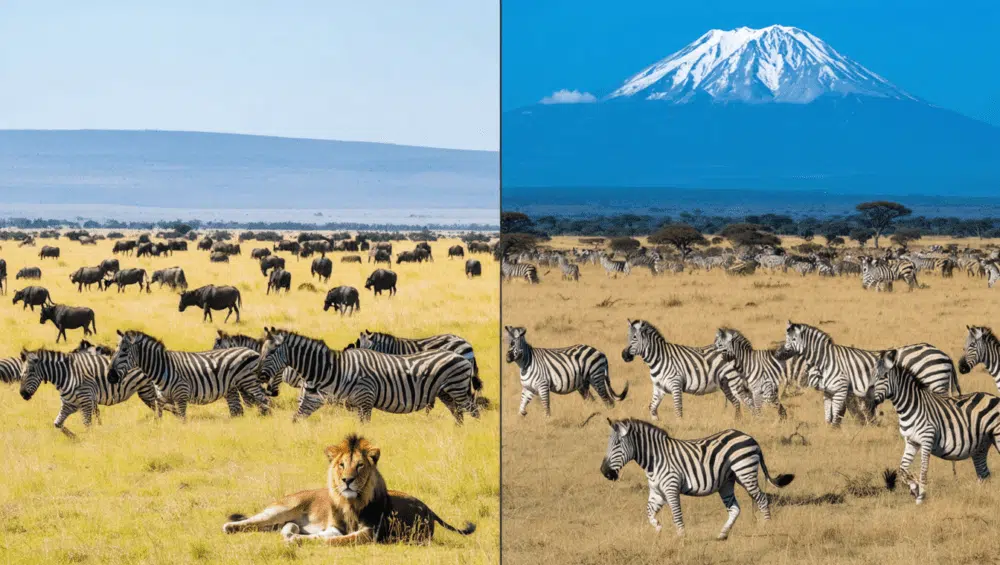
10-Day Kenya and Tanzania Safari Itinerary: Masai Mara to Serengeti
A Kenya and Tanzania safari is one of the most rewarding ways to experience East Africa’s wildlife, landscapes and cultural heritage in a single holiday. By combining Kenya’s famous Masai Mara National Reserve with Tanzania’s legendary Serengeti National Park, travellers can explore two remarkable wildlife destinations connected by the same wider ecosystem.
A 10-day safari provides enough time to enjoy extended game drives in both countries, experience the Great Migration when seasonal conditions are favourable, and add the spectacular Ngorongoro Crater to the journey.
The route begins in Nairobi, continues to the Masai Mara, crosses into Tanzania through the Isebania–Sirari border and proceeds to the Serengeti. The final part of the journey explores Ngorongoro before ending in Arusha or at Kilimanjaro International Airport.
This itinerary is designed for travellers who want a balanced combination of wildlife viewing, comfortable accommodation, scenic road journeys and memorable experiences without rushing through every destination.
Why Choose a Kenya and Tanzania Safari?
Kenya and Tanzania are home to some of Africa’s most celebrated wildlife destinations. Although the countries share an extensive ecosystem, each offers a different safari experience.
Kenya’s Masai Mara is famous for its open grasslands, large predator populations and seasonal wildebeest migration. Tanzania’s Serengeti is much larger and offers extensive plains, varied habitats and opportunities to follow wildlife across different regions throughout the year.
Combining the two destinations allows visitors to experience more of the Great Migration ecosystem while exploring different landscapes and conservation areas.
A combined safari offers several advantages:
- Two world-famous wildlife destinations: Explore the Masai Mara and Serengeti on one holiday.
- Great Migration opportunities: Plan around the seasonal movements of wildebeest and zebra.
- Big Five viewing: Search for lions, elephants, leopards, buffaloes and rhinoceroses.
- Different landscapes: Experience open savannah, woodland, river systems, volcanic highlands and crater scenery.
- Cultural experiences: Learn about local communities and traditions through responsible, locally arranged visits.
- Flexible travel options: Choose road transfers, scheduled flights or a combination depending on your budget and available time.
For first-time visitors to East Africa, a Kenya and Tanzania safari provides an excellent introduction to the region’s wildlife and natural heritage.
10-Day Kenya and Tanzania Safari Itinerary
This suggested itinerary starts in Nairobi and ends in Arusha or Kilimanjaro. It includes three nights in the Masai Mara, three nights in the Serengeti and a visit to Ngorongoro Crater.
The route can be adjusted according to travel dates, accommodation preferences, wildlife interests and whether you prefer road transfers or flights.
Day 1: Arrival in Nairobi, Kenya
Your safari begins when you arrive in Nairobi, Kenya’s capital city. Depending on your international flight schedule, you will be welcomed at the airport and transferred to your hotel.
Use the first day to relax, recover from your journey and prepare for the safari.
If you arrive early, you may have time to explore selected Nairobi attractions, depending on opening hours and your transfer arrangements. Possible activities include visiting the Giraffe Centre, exploring the Karen area or enjoying a city sightseeing experience.
Your safari team can also brief you on the itinerary, packing requirements, park regulations and travel arrangements.
Overnight: Nairobi hotel.
Day 2: Nairobi to Masai Mara National Reserve
After breakfast, depart Nairobi for the Masai Mara National Reserve.
The road journey takes you through Kenya’s Great Rift Valley, offering opportunities to appreciate the dramatic escarpments, rural settlements and changing landscapes along the way.
You will continue towards the Mara region, arriving at your lodge or tented camp in time for lunch or an afternoon activity, depending on the departure time and road conditions.
After settling in, enjoy your first afternoon game drive.
The Masai Mara is known for its rich wildlife populations. Look out for elephants, giraffes, zebras, wildebeest, buffaloes and several antelope species. Lions, cheetahs and leopards are among the predators that make the reserve particularly exciting.
Overnight: Masai Mara lodge or tented camp.
Day 3: Full-Day Game Drive in the Masai Mara
Spend a full day exploring the Masai Mara.
An early morning game drive offers opportunities to observe wildlife when temperatures are cooler and many animals are active. Your guide will help you search for predators, grazing herds and other wildlife across the reserve.
The Mara is particularly famous for its large lion populations, but sightings vary with location, season and natural conditions.
You can either return to camp for lunch and an afternoon game drive or arrange a full-day excursion with a packed lunch, subject to your accommodation and reserve arrangements.
During the Great Migration season, the Mara River area can provide opportunities to observe wildebeest and zebra gathering near crossing points. River crossings are natural events and cannot be guaranteed on a particular day.
Overnight: Masai Mara lodge or tented camp.
Day 4: More Wildlife Experiences in the Masai Mara
Enjoy another full day in the Masai Mara, allowing more time to explore different sections of the reserve or a nearby conservancy.
A second full day is valuable because wildlife sightings are never guaranteed in one location. Moving through different habitats can improve your opportunities to see a wider range of animals.
Depending on your interests and accommodation location, activities may include:
- Morning and afternoon game drives.
- Searching for big cats across open grasslands.
- Exploring riverine habitats and seasonal wetlands.
- Birdwatching and wildlife photography.
- A responsibly arranged cultural visit with a local Maasai community.
Some conservancies offer additional activities such as guided nature walks or night drives, subject to their individual regulations. These activities should not be assumed to be available inside the main national reserve.
Overnight: Masai Mara lodge or tented camp.
Day 5: Masai Mara to Serengeti via Isebania–Sirari Border
Today is one of the most important travel days on your Kenya and Tanzania safari.
After breakfast, depart the Masai Mara and travel towards the Isebania border crossing on the Kenyan side, which connects to Sirari in Tanzania.
At the border, you will complete the required immigration and customs procedures. Your safari operator will coordinate the onward arrangements, including the vehicle and guide transfer where required.
Once you enter Tanzania, continue towards Serengeti National Park.
The road transfer can take much of the day, depending on your starting location in the Mara, border processing, road conditions and the location of your accommodation in the Serengeti.
Arrive at your camp or lodge, settle in and enjoy dinner.
Important: There is no direct tourist border crossing between the Masai Mara and Serengeti through the parks themselves. The overland journey uses an official international border crossing. Travellers should not plan to drive directly across the shared park boundary.
Overnight: Serengeti lodge or tented camp.
Day 6: Full-Day Game Drive in Serengeti National Park
Wake up in Tanzania’s Serengeti National Park, one of Africa’s most celebrated wildlife destinations.
The Serengeti is famous for its extensive grasslands, wildlife populations and annual Great Migration. Its ecosystems support large numbers of wildebeest, zebras, gazelles and predators.
After breakfast, head out for a game drive with your professional safari guide.
Depending on the location and season, you may encounter:
- Lions resting in the grass or moving across the plains.
- Leopards in woodland and riverine habitats.
- Cheetahs hunting in open areas.
- Elephants moving between feeding areas.
- Wildebeest and zebra herds.
- Hyenas, jackals and numerous bird species.
The Serengeti is a large ecosystem, so the best wildlife-viewing area depends on the time of year. Your guide should select the most appropriate region based on seasonal wildlife movements and your accommodation location.
Overnight: Serengeti lodge or tented camp.
Day 7: Explore More of the Serengeti
Enjoy another full day in the Serengeti.
A second full day gives you additional time to explore the plains and follow wildlife activity without spending the entire visit rushing between destinations.
The Great Migration is one of the main attractions of the Serengeti ecosystem. Large herds of wildebeest and zebra move through different regions in response to rainfall and the availability of fresh grazing.
The timing and location of the herds change throughout the year. Your itinerary should therefore be planned around the expected seasonal movements rather than assuming the animals will always be in one particular area.
Depending on your travel dates, your guide may recommend:
- The southern Serengeti and Ndutu region during the calving season.
- The western Serengeti during parts of the migration’s westward movement.
- The northern Serengeti when herds move towards the Mara River region.
- Central Serengeti for year-round wildlife viewing and predator sightings.
Optional experiences, such as a hot-air balloon safari, may also be available in selected areas. These require advance booking and depend on local operating conditions.
Overnight: Serengeti lodge or tented camp.
Day 8: Serengeti to Ngorongoro Conservation Area
After breakfast, depart the Serengeti and travel towards the Ngorongoro Conservation Area.
The journey provides opportunities to appreciate Tanzania’s changing landscapes, from the Serengeti plains to the highland environment around Ngorongoro.
Depending on your route and timing, you may enjoy additional wildlife viewing along the way.
Ngorongoro is famous for its enormous volcanic caldera, which contains grasslands, woodland, wetlands and a shallow alkaline lake. The crater supports a remarkable concentration of wildlife and is one of Tanzania’s most recognised safari destinations.
Arrive at your accommodation near the crater rim or in the Karatu area.
Spend the evening relaxing and preparing for the following day’s crater excursion.
Overnight: Ngorongoro or Karatu lodge.
Day 9: Ngorongoro Crater Safari and Transfer to Arusha
Start early and descend into Ngorongoro Crater for a game drive.
The crater is part of a large volcanic caldera and provides a distinctive wildlife-viewing environment. Its varied habitats support elephants, buffaloes, zebras, wildebeest, hippos, lions and other species.
The area is also important for black rhinoceros conservation. Although sightings are possible, they are never guaranteed.
Enjoy a guided game drive through the crater, with time to appreciate its wildlife and scenery.
After the crater excursion, travel towards Arusha. Depending on the arrangements, you can spend the night in Arusha or near Kilimanjaro International Airport.
Overnight: Arusha or Kilimanjaro area.
Day 10: Departure from Arusha or Kilimanjaro International Airport
After breakfast, transfer to Arusha Airport or Kilimanjaro International Airport for your onward flight.
If your departure schedule allows, you may have time for a short visit or a relaxed morning in Arusha.
Your 10-day Kenya and Tanzania safari ends with memories of two iconic wildlife destinations, diverse landscapes and unforgettable East African experiences.
Best Time to Plan a Kenya and Tanzania Safari
The best time for a combined safari depends on the wildlife experiences you want, particularly if seeing the Great Migration is a priority.
The migration is a continuous movement of wildebeest, zebra and other grazing animals through the Serengeti–Mara ecosystem. It does not happen in exactly the same place or on fixed dates every year.
January to March: Calving Season in the Southern Serengeti
The southern Serengeti and Ndutu region are important during the calving season.
Large numbers of wildebeest give birth during this period, attracting predators such as lions, cheetahs and hyenas.
This period is particularly attractive for visitors interested in predator activity and young wildlife.
April to May: Green Season
April and May generally bring heavier rainfall to parts of the region.
The landscapes become greener, and some accommodation providers may offer seasonal rates. However, rain can affect road conditions and certain travel arrangements.
Travellers should confirm camp operations and road accessibility before booking.
June: Migration Through the Western Serengeti
As the herds move north and west, parts of the western Serengeti can offer rewarding wildlife experiences.
The exact timing of migration activity varies with rainfall and grazing conditions.
July to October: Northern Serengeti and Masai Mara
This is a popular period for travellers hoping to see the migration in the northern Serengeti and Masai Mara.
The Mara River is associated with dramatic crossing events, but these depend on herd movements and natural conditions.
A river crossing cannot be guaranteed simply by booking a particular month.
November to December: Movement Towards the Southern Plains
As seasonal rains develop, many herds begin moving southwards through the Serengeti ecosystem.
This period can provide opportunities to enjoy greener scenery and wildlife viewing in different parts of the park.
For the most suitable itinerary, match your accommodation location and number of nights to the expected position of the herds during your travel dates.
How to Cross from Kenya to Tanzania on Safari
Cross-border logistics are an important part of a Kenya and Tanzania safari.
Although the Masai Mara and Serengeti are part of the same wider ecosystem, they are separated by an international border. Travellers must use an authorised crossing point and complete the required immigration procedures.
Isebania–Sirari Border Crossing
The Isebania–Sirari crossing is a commonly used overland route for travellers moving between the Masai Mara and northern Tanzania.
The typical arrangement involves:
- Departing the Masai Mara with your Kenyan safari guide.
- Travelling towards Isebania.
- Completing Kenyan exit formalities.
- Crossing into Tanzania through Sirari.
- Completing Tanzanian entry formalities.
- Meeting your Tanzanian guide and vehicle where required.
- Continuing towards the Serengeti.
The exact arrangements depend on the safari operator, vehicle permissions and itinerary.
Can You Drive Directly from Masai Mara to Serengeti?
No. Visitors cannot simply drive from the Masai Mara into the Serengeti through the shared park boundary.
The tourist crossing near Sand River and Bologonja is not an open international tourist route. Travellers need to use an authorised border post or arrange an appropriate flight connection.
This is why the Isebania–Sirari crossing is important when planning an overland itinerary.
Is Flying Better Than Driving?
Flying can reduce the time spent travelling between destinations, particularly for visitors with limited holiday time.
However, it may involve additional flight costs, baggage restrictions, airport transfers and coordination between different safari operators.
Driving can provide a more affordable option for some itineraries and offers a chance to experience the changing landscapes between the two countries. The border transfer should be planned as a substantial travel day rather than a short journey.
What Animals Can You See on a Kenya and Tanzania Safari?
The Masai Mara, Serengeti and Ngorongoro support a wide variety of wildlife.
The most sought-after animals include the African Big Five:
Lion: Both the Masai Mara and Serengeti support important lion populations. Guides often search around grasslands, rocky outcrops and areas where prey animals gather.
Leopard: Leopards are elusive and may be seen resting in trees, moving through woodland or near riverine vegetation.
Elephant: Elephants are found in different habitats across the safari route, including woodland and open savannah.
Buffalo: Large herds of African buffalo can be seen grazing across grasslands and near water sources.
Rhinoceros: Black rhinoceroses are protected in selected conservation areas, including Ngorongoro. Sightings depend on location and natural conditions.
Other animals include cheetahs, giraffes, zebras, wildebeest, hyenas, hippos, crocodiles, gazelles and numerous bird species.
Wildlife viewing is never guaranteed. A responsible guide will prioritise animal welfare, safe viewing distances and park regulations.
What Is Included in a Kenya and Tanzania Safari Package?
The inclusions depend on the operator, accommodation category and whether the itinerary is private or shared.
A well-organised package may include:
- Airport transfers in Nairobi and Tanzania.
- Accommodation for the agreed number of nights.
- Meals as specified in the itinerary.
- Private or shared safari transport.
- Professional driver-guides.
- Game drives in the Masai Mara and Serengeti.
- Ngorongoro Crater excursion.
- Park and conservation fees, where explicitly included.
- Border transfer coordination.
- Drinking water during game drives, where provided.
Before confirming a booking, request a written breakdown of all inclusions and exclusions.
Check whether the quotation includes park entry fees, concession fees, crater vehicle charges, international flights, visas, travel insurance, tips, optional activities and any additional border-transfer costs.
Do not assume that every advertised safari package includes all these expenses.
What Should You Pack for a 10-Day Kenya and Tanzania Safari?
Packing appropriately can make a long safari more comfortable.
Consider taking:
- Lightweight neutral-coloured clothing.
- A warm jacket or fleece for early mornings.
- Comfortable walking shoes.
- A wide-brimmed hat.
- Sunglasses and sunscreen.
- Insect repellent.
- Binoculars for wildlife viewing.
- A camera and spare batteries.
- Personal medication and basic travel essentials.
- A reusable water bottle.
- Travel documents and copies of important bookings.
If your itinerary includes small aircraft flights, confirm luggage weight and bag-size restrictions before departure. Soft-sided luggage is often more practical for light aircraft transfers.
Important Travel Documents and Border Requirements
A combined safari involves travelling between two countries, so documentation should be checked before departure.
Travellers should confirm:
- Passport validity and entry requirements for both countries.
- Whether separate Kenyan and Tanzanian visas or travel authorisations are required for their nationality.
- Immigration and border-crossing arrangements.
- Yellow fever certificate requirements based on their travel history and applicable public-health rules.
- Travel insurance covering the planned activities.
- Any required permits or documentation for children travelling with adults.
Requirements can change, and nationality, previous travel and transit routes may affect what is needed. Confirm current requirements with the relevant immigration and public-health authorities before travelling.
Book Your Kenya and Tanzania Safari Adventure
A 10-day journey from the Masai Mara to the Serengeti offers an excellent introduction to East Africa’s most celebrated wildlife destinations.
From the open plains of Kenya to Tanzania’s vast Serengeti ecosystem and the remarkable Ngorongoro Crater, the itinerary combines wildlife viewing, scenic travel and unforgettable experiences.
The best safari is one planned around your travel dates, wildlife interests, accommodation preferences and available budget. Whether you prefer a comfortable mid-range lodge, a luxury tented camp or a private fly-in safari, the route can be adapted to suit your expectations.
Contact a specialist safari team to discuss your preferred travel dates, group size and accommodation category. A customised itinerary can help you make the most of every day while ensuring that border transfers, park visits and overnight stays are properly coordinated.
Frequently Asked Questions About Kenya and Tanzania Safari
Can you visit Kenya and Tanzania on one safari?
Yes. Travellers can combine Kenya and Tanzania in one safari by visiting destinations such as the Masai Mara, Serengeti and Ngorongoro Crater. The journey can be organised using road transfers, flights or a combination of both.
How many days do you need for a Kenya and Tanzania safari?
Ten days is a good starting point for visiting the Masai Mara, Serengeti and Ngorongoro Crater. Travellers with more time can add destinations such as Amboseli, Lake Manyara or Tarangire.
Can you travel directly from Masai Mara to Serengeti?
No. There is no direct tourist border crossing between the two parks. Overland travellers generally use the Isebania–Sirari border, complete immigration procedures and continue into Tanzania with the required transport arrangements.
What is the best time for a Kenya and Tanzania safari?
July to October is popular for visitors hoping to see migration activity in the northern Serengeti and Masai Mara. January to March is attractive for the calving season in the southern Serengeti. The best time depends on the wildlife experience you want.
Can you see the Big Five on a Kenya and Tanzania safari?
Yes. The Masai Mara, Serengeti and Ngorongoro support populations of the Big Five: lion, leopard, elephant, buffalo and rhinoceros. However, seeing all five during one trip is never guaranteed.
Is it better to drive or fly between Kenya and Tanzania?
Driving can offer a more economical overland experience, while flying can reduce transfer time. The best option depends on your budget, available days, luggage requirements and preferred travel style.
Does a Kenya and Tanzania safari include the Great Migration?
A safari can be planned around the Great Migration, but the herds move according to rainfall and grazing conditions. Their location changes throughout the year, so the itinerary should be designed around seasonal patterns rather than fixed crossing dates.
Do I need separate visas for Kenya and Tanzania?
Visa requirements depend on your nationality and travel circumstances. Some travellers may need separate entry permissions for each country. Confirm the current rules with the relevant immigration authorities before booking.
What should I budget for a 10-day Kenya and Tanzania safari?
The cost depends on the season, accommodation category, group size, transport method, park fees and package inclusions. Request a personalised quotation that clearly separates included services from additional expenses.
Can families take a Kenya and Tanzania safari?
Yes. Many safari lodges and camps accommodate families, although age restrictions and activity rules vary. Families should discuss room arrangements, child-friendly activities, vehicle requirements and transfer times with their safari operator before booking.