
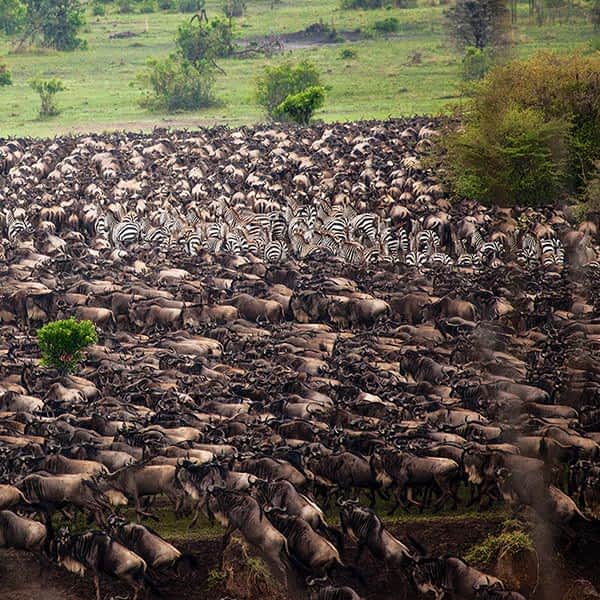
Serengeti in January and February: The Spectacular Calving Season on the Southern Plains
Serengeti January and February are among the most exciting months for travellers interested in the Great Migration, particularly the annual wildebeest calving season in the southern Serengeti and Ndutu area.
Rather than focusing on river crossings, these months are about newborn wildebeest, abundant grazing, predator activity and dramatic photographic opportunities.
The exact location of the herds varies with rainfall and pasture conditions, but the southern Serengeti and wider Ndutu ecosystem are traditionally important areas during the calving period.
For travellers planning a Serengeti January safari, the attraction is not simply the number of animals.
It is the behaviour.
Thousands of wildebeest gather in open grasslands.
Calves are born in large numbers.
Predators take advantage of the abundance.
And the landscape can be greener and more vibrant than during the dry-season months.
Serengeti January: Why January Is a Special Safari Month
Serengeti January offers a compelling combination of green landscapes, large herbivore concentrations and the beginning of the annual calving period in the southern ecosystem.
January falls within the period when the wildebeest herds are generally associated with the southern Serengeti and Ndutu ecosystem, although their precise position changes according to rainfall.
This makes January attractive for travellers who want to experience the migration without making river crossings the centre of their safari.
The landscape can also be visually spectacular.
Recent rains can transform dry grasslands into greener plains, while clouds and changing light create excellent conditions for photography.
Serengeti February: The Heart of the Calving Season
Serengeti February is particularly famous for calving, with large numbers of wildebeest calves born across the southern plains and Ndutu area during favourable conditions.
The exact timing varies from year to year.
Rainfall is one of the major influences.
When the rains produce fresh grass, the herds have an important reason to remain in the southern ecosystem.
This creates one of the most remarkable wildlife spectacles in Tanzania.
A morning game drive can involve thousands of wildebeest spread across the plains, while predators patrol the same landscape.
For travellers interested in wildlife behaviour, Serengeti February calving can be an exceptional experience.
Serengeti January and February: Where Are the Herds?
During Serengeti January and February, the migration is commonly associated with the southern Serengeti and Ndutu ecosystem, but the herds do not follow a fixed calendar.
This distinction is important.
The Great Migration is not an event that happens at exactly the same location every year.
The animals respond to:
- Rainfall.
- Fresh grass.
- Water availability.
- Local conditions.
- Herd behaviour.
- Predator pressure.
The southern plains can therefore be a strong choice for January and February, but experienced safari planners avoid guaranteeing an exact herd position months in advance.
The best approach is to plan around the seasonal pattern while allowing for natural variation.
Serengeti January and February: Understanding Ndutu
Ndutu is one of the most important areas associated with the southern Serengeti calving season and can be an excellent base for travellers targeting newborn wildebeest and predator action.
Ndutu sits within the wider ecosystem spanning the southern Serengeti and Ngorongoro Conservation Area.
Its location makes it particularly interesting during the calving period.
The surrounding plains can attract:
- Wildebeest.
- Zebra.
- Gazelles.
- Lions.
- Cheetahs.
- Leopards.
- Hyenas.
- Jackals.
- Numerous bird species.
The experience is about the entire ecosystem rather than one individual species.
Serengeti January and February: The Wildebeest Calving Season
The defining attraction of the Serengeti February calving season is the birth of large numbers of wildebeest calves across the southern plains.
Calving usually occurs over a relatively concentrated period, although births continue throughout the season.
For visitors, this creates unusual wildlife behaviour.
Adult wildebeest become highly protective of their young.
Newborn calves must become mobile quickly because predators are nearby.
The result is an ecosystem in constant motion.
A game drive may shift from observing a large herd to watching a predator stalking the edge of the group.
Serengeti January and February: Why Predators Follow the Herds
The concentration of young animals creates excellent conditions for predators, making January and February particularly rewarding for travellers interested in predator-prey behaviour.
Lions are among the most obvious predators to watch.
But the ecosystem also includes:
- Cheetahs.
- Leopards.
- Hyenas.
- Jackals.
Young wildebeest are vulnerable during their first days of life.
However, predators do not simply wait for newborns.
They also hunt adult animals, zebra and other herbivores.
This means the southern Serengeti can offer a broad range of wildlife encounters.
Serengeti January and February: Lions on the Southern Plains
Lions can be particularly rewarding to watch during the calving season because the concentration of prey creates opportunities for hunting and other social behaviour.
The southern Serengeti is home to resident lion populations as well as other predators.
A good guide will not simply search for lions.
They will interpret behaviour.
Look for:
- Pride interactions.
- Cubs.
- Hunting preparation.
- Territorial behaviour.
- Mating behaviour.
- Feeding.
- Resting.
The ability to spend time observing a pride can be more rewarding than simply finding a lion and leaving immediately.
Serengeti January and February: Cheetah Photography
The open grasslands around the southern Serengeti can provide excellent opportunities to observe cheetahs, particularly when visibility across the plains is good.
Cheetahs rely heavily on sight when hunting.
Open terrain allows them to scan for prey.
During the calving season, young herbivores can create additional hunting opportunities.
Photographers should be prepared for sudden action.
A cheetah may appear relaxed for several minutes before rapidly accelerating toward prey.
This is where good positioning, patience and an experienced guide become valuable.
Serengeti January and February: Leopard Sightings
Leopards remain less predictable than some other predators, but the wider Serengeti ecosystem supports them throughout the year.
Leopards are often associated with:
- Woodland edges.
- Riverine vegetation.
- Trees.
- Rocky areas.
They are generally more difficult to find than lions.
A January or February safari should therefore not be planned solely around leopard sightings.
Instead, consider the broader wildlife experience.
If you encounter a leopard, it becomes an added highlight.
Serengeti January and February: Photography Opportunities
Serengeti January and February can be excellent months for wildlife photography because green landscapes, newborn animals, predator activity and dramatic skies create varied compositions.
Photographers can capture:
- Wildebeest herds.
- Newborn calves.
- Lions.
- Cheetahs.
- Zebra.
- Gazelles.
- Predators stalking prey.
- Birds of prey.
- Dramatic landscapes.
The greener scenery can also provide more colour contrast than the dry-season landscape.
Early morning and late afternoon remain particularly important for attractive light.
Serengeti January and February: What Is the Weather Like?
January and February generally fall within Tanzania’s warmer period, with relatively green conditions in the southern Serengeti and the possibility of rain associated with the season.
Weather can vary considerably from one day to another.
Travellers should expect:
- Warm daytime conditions.
- Cooler early mornings.
- Possible rain showers.
- Cloudy periods.
- Variable road conditions.
Rain does not necessarily mean that a safari is ruined.
In fact, rain can create some of the most dramatic scenery.
The important thing is to pack appropriately.
Serengeti January and February: Is It Rainy All Day?
No, rain during the January and February period does not automatically mean continuous rainfall throughout the safari day.
Rain can be:
- Localised.
- Short-lived.
- Intermittent.
- Heavier in some areas than others.
A safari can continue through many weather conditions.
Your guide will monitor local conditions and road access while adjusting the day’s route where necessary.
Serengeti January and February: What Should You Pack?
Packing for Serengeti January and February requires flexibility because travellers can experience warm afternoons, cool mornings and rain during the same trip.
Useful items include:
- Lightweight trousers.
- Long-sleeved shirts.
- Fleece or light jacket.
- Waterproof jacket.
- Comfortable walking shoes.
- Hat.
- Sunglasses.
- Sunscreen.
- Insect repellent.
- Camera equipment.
- Spare camera batteries.
- Binoculars.
Neutral colours are generally practical for safari.
Comfort should take priority over fashion.
Serengeti January and February: What Are the Roads Like?
Rain can affect some roads in the southern Serengeti, so travellers should expect conditions to vary according to recent rainfall and local terrain.
This is one reason an experienced safari operator matters.
Road conditions can influence:
- Which tracks are accessible.
- How long transfers take.
- Where game drives can go.
- Whether certain areas are temporarily avoided.
Travellers should understand that a safari is conducted in a natural environment.
Conditions are not always predictable.
Serengeti January and February: How Long Should You Stay?
A three- to four-night stay in the southern Serengeti or Ndutu area gives travellers a much better chance to experience the calving season than a rushed one-night visit.
A sample itinerary might be:
Day 1
Arrive in the Serengeti or southern ecosystem.
Day 2
Full-day game drive.
Day 3
Full-day game drive focusing on herds and predators.
Day 4
Morning game drive and onward transfer.
Longer stays are particularly useful for photographers.
Wildlife does not operate according to a timetable.
Serengeti January and February: How Does It Compare With Other Months?
Serengeti January and February are strongest for travellers who prioritise calving, predators and green landscapes rather than dry-season river crossings.
| Period | Main Attraction |
|---|---|
| January | Southern plains and early calving activity |
| February | Peak calving opportunities |
| March | Continued migration and changing conditions |
| April–May | Green season and lower-season travel |
| June–July | Northern movement and dry-season safari |
| August–September | River-crossing opportunities |
| October | Northern Serengeti wildlife |
| November–December | Short rains and herd movement |
These patterns are seasonal rather than guaranteed.
Serengeti January and February: Is This a Good Time for First-Time Visitors?
Yes, especially for travellers who want to see a different side of the Great Migration from the famous river crossings.
Many first-time visitors hear about the migration and immediately think of crocodile-filled rivers.
But the migration is much more than that.
The calving season demonstrates another part of the cycle:
birth → growth → movement → survival
Seeing thousands of herbivores spread across the plains provides an entirely different perspective on the ecosystem.
Serengeti January and February: Is It Good for Families?
January and February can be excellent for families interested in seeing large herds and young animals, but the safari should be designed around manageable driving times and family-friendly accommodation.
Parents should consider:
- Children’s ages.
- Private vehicle availability.
- Length of game drives.
- Accommodation facilities.
- Meal arrangements.
- Transfer times.
A private vehicle provides greater flexibility.
If children become tired, the family can return to camp without affecting other guests.
Serengeti January and February: Is It Good for Honeymoons?
For couples, the calving season combines dramatic wildlife experiences with beautiful green landscapes and can be an excellent alternative to the busier dry-season migration periods.
A honeymoon itinerary could combine:
Serengeti → Ngorongoro → Zanzibar
This gives couples:
- Wildlife.
- Scenic landscapes.
- Romantic camp experiences.
- Beach relaxation.
A private vehicle can also provide greater flexibility during game drives.
Serengeti January and February: Is It Good for Photographers?
Yes, particularly for photographers interested in animal behaviour, newborn wildlife and predator-prey interactions.
The strongest opportunities can include:
- Wildebeest calves.
- Predators.
- Large herds.
- Green plains.
- Storm clouds.
- Sunrise.
- Sunset.
- Birds of prey.
Photographers should bring:
- Telephoto lens.
- Wide-angle lens.
- Extra batteries.
- Memory cards.
- Dust protection.
- Rain protection.
A beanbag or suitable vehicle support can also be useful for longer-lens photography.
Serengeti January and February: Private vs Shared Safari
A private safari is particularly useful during calving season because wildlife behaviour can require patience and flexible positioning.
With a private vehicle, you can:
- Stay longer at interesting sightings.
- Change the day’s route.
- Spend more time photographing.
- Return to camp when needed.
- Adapt to weather conditions.
Shared safaris can be more economical.
The choice depends on budget and travel priorities.
Serengeti January and February: How Much Does It Cost?
The cost of a Serengeti January or February safari depends heavily on accommodation level, number of nights, vehicle type, park fees, flights and whether the itinerary includes the Ndutu area.
A quotation should clearly separate:
- Accommodation.
- Safari vehicle.
- Guide.
- Park fees.
- Conservation fees.
- Airport transfers.
- Internal flights.
- Meals.
- Drinks.
- Activities.
Peak calving-season accommodation can command strong demand, so early planning is advisable.
Serengeti January and February: Booking Early
Travellers targeting the Ndutu calving season should consider booking well ahead because the most strategically located accommodation can be in high demand during the peak period.
This is particularly important for:
- Honeymoons.
- Christmas and New Year extensions.
- Family holidays.
- Photography trips.
- Private safaris.
Booking early provides more choice.
Waiting until the last minute can mean accepting a property farther from your preferred wildlife area.
Serengeti January and February: Common Planning Mistakes
The biggest mistake is treating the calving season as a guaranteed wildlife schedule rather than a seasonal pattern influenced by rainfall and ecological conditions.
Avoid:
Expecting exact herd locations
The animals move.
Booking only one night
You need time for wildlife encounters.
Focusing only on newborns
The entire predator ecosystem is part of the experience.
Ignoring accommodation location
Transfer time matters.
Underpacking for rain
Weather can change quickly.
Planning around photographs from one specific year
Conditions vary annually.
Serengeti January and February: Frequently Asked Questions
Is January a good month for the Serengeti?
Yes. January can be an excellent month for green landscapes, wildlife concentrations and the beginning of the southern calving period.
Is February the best month for Serengeti calving?
February is traditionally one of the strongest months for calving, particularly around the southern Serengeti and Ndutu ecosystem, although exact conditions vary each year.
Where is the Serengeti migration in January?
The herds are commonly associated with the southern Serengeti and Ndutu area during this period, but rainfall and pasture conditions influence their precise location.
Where is the Serengeti migration in February?
February is commonly associated with the southern plains and Ndutu calving ecosystem, although the herds can move depending on environmental conditions.
What is the Ndutu calving season?
The Ndutu calving season refers to the period when large numbers of wildebeest give birth in the southern Serengeti and surrounding ecosystem, generally around January and February.
Can I see predators during calving season?
Yes. Lions, cheetahs, hyenas and other predators are drawn to areas where large numbers of prey and newborn animals are concentrated.
Is January or February better for photography?
Both can be excellent. February may offer particularly strong opportunities for newborns and predator activity, while January can provide excellent green landscapes and early calving scenes.
Does it rain in the Serengeti in January and February?
Rain is possible and conditions vary. Travellers should expect showers and changing weather rather than assuming either month will be completely dry.
How many days should I spend in the Serengeti?
Three or four nights is a useful starting point for a calving-season safari, while longer stays provide more flexibility.
Is the Serengeti expensive in January and February?
Prices depend on accommodation and itinerary. Popular calving-season areas can be in strong demand, so early booking is recommended.
Conclusion: Why Serengeti January and February Deserve a Place on Your Safari Calendar
Serengeti January and February offer one of Tanzania’s most compelling wildlife experiences: the annual calving season across the southern plains.
The attraction is not simply the sight of newborn wildebeest.
It is the complete ecosystem.
Large herds gather around fresh grazing.
Calves are born.
Predators become active.
Birds follow the movement of prey.
The green plains create beautiful photographic conditions.
And every day can bring something different.
For travellers planning a Serengeti January safari, the southern Serengeti and Ndutu ecosystem should be considered carefully.
For those travelling in February, Serengeti February calving can provide some of the most dramatic predator and newborn-animal encounters of the year.
The key is to plan around the season without treating nature as a fixed timetable.
Choose the right location.
Allow enough nights.
Use experienced guides.
And leave room for the unexpected.
Plan Your Serengeti Safari With Odysseys From Africa
Odysseys From Africa can create a tailor-made Tanzania safari around the calving season, your preferred accommodation level and the wildlife experiences you want to prioritise.
We can arrange:
- Serengeti calving-season safaris.
- Ndutu safaris.
- Great Migration itineraries.
- Ngorongoro Crater safaris.
- Tarangire safaris.
- Private safari vehicles.
- Photography safaris.
- Family safaris.
- Honeymoon safaris.
- Kenya Tanzania combined safaris.
- Zanzibar beach extensions.