
Birding Safari: Remarkable East Africa Birdwatching Seasons Month by Month
A birding safari in East Africa can be rewarding throughout the year, but the species, migration activity, breeding behaviour and weather conditions change considerably from month to month.
Kenya, Tanzania, Uganda and Rwanda offer an exceptional variety of habitats within relatively accessible safari circuits.
A single birding safari can potentially combine:
- Savannah.
- Wetlands.
- Lakes.
- Forest.
- Mountains.
- Coastlines.
- River systems.
- Acacia woodland.
The best time depends on what you want to see.
Some travellers want migratory birds.
Others are looking for endemic species.
Others want to combine birdwatching with the Great Migration or a traditional big-game safari.
This month-by-month guide explains how to think about an East African birding safari throughout the year.
Birding Safari: What Makes East Africa So Good for Birdwatching?
An East Africa birding safari is exceptional because the region combines dramatically different habitats, altitudes and ecosystems within relatively short travel distances.
Depending on your route, a birding safari may include:
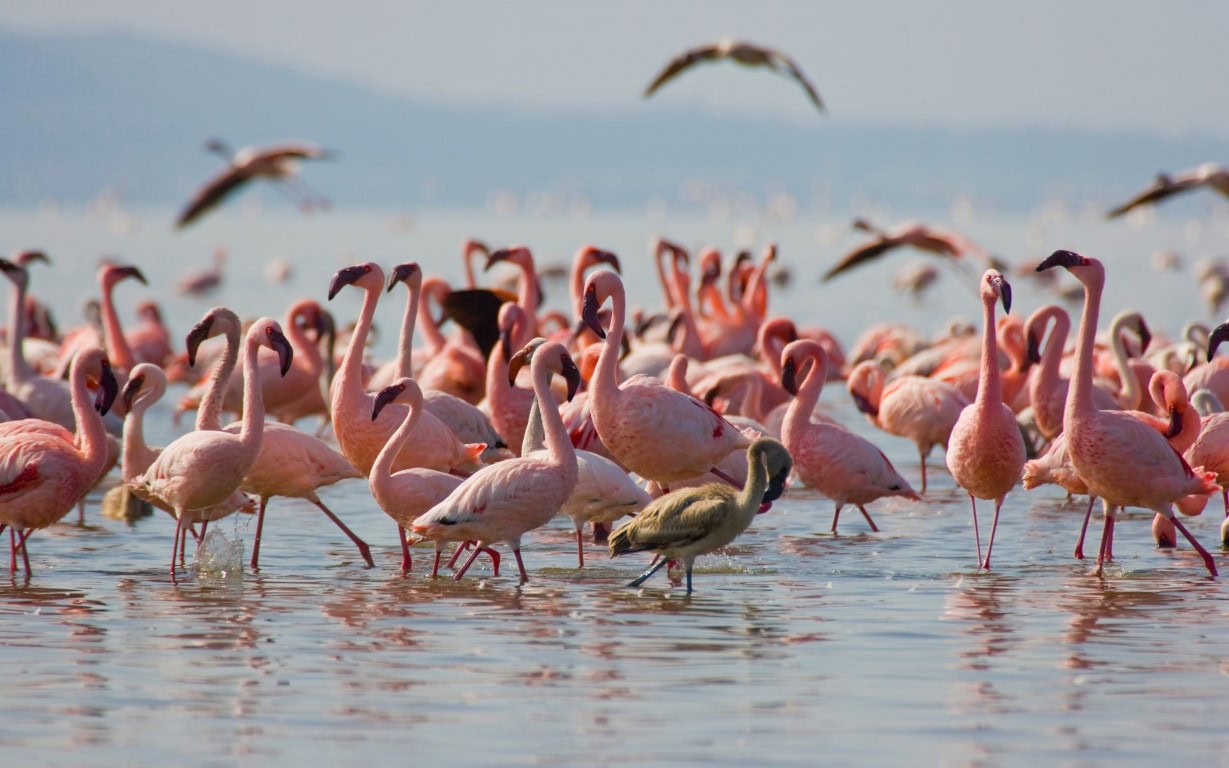
- Flamingo-filled lakes.
- Dry savannah.
- Afro-montane forest.
- Coastal forest.
- Freshwater wetlands.
- Rift Valley lakes.
- Highland grasslands.
- Riverine woodland.
This habitat diversity supports a remarkable range of bird species.
The experience can also be structured around other wildlife interests.
You can combine a birding-focused itinerary with:
- Big Five viewing.
- The Great Migration.
- Gorilla trekking.
- Chimpanzee trekking.
- Beach extensions.
- Walking safaris.
Birding Safari: January
January is often an excellent period for a birding safari because many areas are green after seasonal rains and migratory birds may still be present.
Across parts of East Africa, landscapes can be productive and bird activity can be high.
A January birding safari can focus on:
- Wetland birds.
- Migratory species.
- Savannah birds.
- Forest species.
- Resident species in breeding condition.
January can also work well for combining birdwatching with a conventional safari.
In northern Tanzania, for example, the southern Serengeti ecosystem can become an important seasonal wildlife area.
Your route can therefore combine birding with broader wildlife viewing.
Birding Safari: February
February can be a productive month for a birding safari, particularly for travellers interested in combining birdwatching with major wildlife activity in northern Tanzania.
Conditions vary between destinations.
Potential highlights can include:
- Migratory birds.
- Breeding activity.
- Wetland species.
- Woodland species.
- Open-country birds.
A February birding safari can be designed around Tanzania’s northern circuit, Kenya’s Rift Valley or specialist forest areas.
Because wildlife viewing can also be strong in several destinations, February suits travellers who want birds without giving up a classic safari experience.
Birding Safari: March
March can offer a productive birding safari before heavier seasonal rains affect some roads and travel conditions in parts of East Africa.
Bird activity remains strong across many habitats.
A March birding safari may focus on:
- Wetlands.
- Lakes.
- Savannah.
- Forest edges.
- Highland areas.
Migratory species may still be present in some areas.
However, migration timing varies by species and location.
A specialist guide can help structure the itinerary around the birds you most want to find.
Birding Safari: April
April can be one of the more challenging months for a birding safari in some areas because heavier rains may affect road access, but the green landscapes can also create excellent birding conditions.
The trade-offs may include:
- Wetter conditions.
- Muddy roads.
- More difficult photography.
- Fewer safari vehicles.
- Green scenery.
- Active birdlife.
For dedicated birders, rain does not automatically make April unsuitable.
A well-planned birding safari can focus on destinations with reliable access and productive habitats.
Birding Safari: May
May continues the green-season birding opportunities in many parts of East Africa, although rainfall and road conditions should be considered when planning a birding safari.
The landscape can be lush.
Birding opportunities may include:
- Forest birds.
- Wetland species.
- Resident birds.
- Species associated with seasonal vegetation.
A May birding safari can offer good value because some traditional safari destinations are outside peak tourism periods.
However, accessibility should always be assessed destination by destination.
Birding Safari: June
June marks a transition toward drier conditions in several East African safari regions and can be an excellent time for a birding safari combined with major wildlife viewing.
As conditions become drier:
- Roads may become easier.
- Wildlife viewing patterns can change.
- Open habitats become easier to explore.
- Safari logistics can become more predictable.
A June birding safari is particularly suitable for travellers who want a mixed itinerary combining birds with large mammals.
Birding Safari: July
July is a popular safari month, and a birding safari can be combined with major wildlife destinations when dry-season conditions make travel and game viewing relatively straightforward.
This is often a busier travel period.
A July birding safari may require earlier booking, particularly when combining birdwatching with popular wildlife destinations.
Consider focusing on:
- Highlands.
- Forests.
- Rift Valley lakes.
- Savannah.
- Specialist birding areas.
Early planning gives you more choice of guides and accommodation.
Birding Safari: August
August can be a strong month for a birding safari that combines dry-season travel with classic wildlife destinations.
The exact birding experience depends heavily on the habitat.
A birding-focused route can deliberately move between ecosystems.
For example:
Savannah → Wetland → Forest → Highland
This habitat variation can increase the diversity of species encountered during the trip.
An August birding safari can also be paired with traditional game viewing in Kenya and Tanzania.
Birding Safari: September
September is often a useful month for a birding safari because dry conditions in several safari areas can make multi-destination travel efficient.
By September, birdwatchers may focus on:
- Resident species.
- Endemic species.
- Habitat specialists.
- Wetland birds.
- Birds of prey.
This can be an excellent period for travellers whose primary goal is finding particular resident or endemic species rather than seasonal migrants.
Birding Safari: October
October can be an important transition month for an East Africa birding safari as seasonal weather patterns begin changing and migratory movements become increasingly relevant.
The exact timing varies.
A specialist birding safari can be designed around:
- Migration.
- Wetland habitats.
- Forest species.
- Highland birds.
- Coastal birds.
October is also a useful month for travellers who prefer shoulder-season travel.
Birding Safari: November
November can be one of the most interesting months for a birding safari because seasonal rains and migratory movements can increase bird activity across many habitats.
Migratory birds become a key consideration for many birdwatchers.
The green landscape can also support:
- Increased insect activity.
- Productive wetlands.
- Breeding behaviour.
- Greater bird diversity in some areas.
A November birding safari can be particularly rewarding for travellers interested in seasonal changes rather than only classic dry-season wildlife viewing.
Birding Safari: December
December can provide an excellent combination of resident birdlife, migratory species and green-season landscapes for an East Africa birding safari.
December itineraries can focus on:
- Migratory birds.
- Wetland species.
- Forest birds.
- Coastal habitats.
- Savannah species.
Because December is also a major holiday travel period, availability can become limited.
Book early if your birding safari includes popular safari camps or beach extensions.
Birding Tanzania Month by Month
Birding Tanzania month by month changes according to rainfall, migration, altitude and habitat, making itinerary design more important than choosing one universally “best” month.
Tanzania offers exceptional habitat diversity.
A birding safari can potentially include:
- Serengeti grasslands.
- Ngorongoro highlands.
- Rift Valley lakes.
- Miombo woodland.
- Southern wilderness.
- Coastal habitats.
- Mountain forests.
The best itinerary depends on your target species.
Birding Tanzania Month: January to March
A birding Tanzania month itinerary during January to March can combine productive birdlife with the northern circuit’s major wildlife experiences.
Potential habitats include:
- Open plains.
- Woodland.
- Wetlands.
- Lakes.
- Highlands.
This period can be especially attractive for travellers who want a combined birding and wildlife itinerary.
Birding Tanzania Month: April and May
April and May can provide productive green-season birding in Tanzania, although rainfall and access should be considered carefully when designing the route.
A dedicated birding itinerary may benefit from:
- Specialist guides.
- Flexible routing.
- Suitable vehicles.
- Accommodation selected around target habitats.
The reward can be a greener and quieter safari experience.
Birding Tanzania Month: June to September
June through September can offer efficient travel conditions for a birding Tanzania month itinerary, particularly when combining birds with classic dry-season wildlife viewing.
These months can be useful for:
- Long-distance itineraries.
- Multi-park routes.
- Mammal and bird combinations.
- Photography-focused trips.
The busiest destinations may require advance planning.
Birding Tanzania Month: October to December
October through December can bring changing weather patterns and important migratory opportunities to a birding Tanzania month itinerary.
This period can be especially appealing to birders interested in seasonal movement.
A guide can help identify the best locations for your target species.
East Africa Birdwatching Seasons: Migration
East Africa birdwatching seasons are strongly influenced by migration, but arrival and departure dates vary by species and should not be treated as exact calendar guarantees.
Migratory birds move in response to:
- Seasonal conditions.
- Food availability.
- Breeding cycles.
- Weather systems.
For this reason, a serious birding itinerary should be designed around:
- Your travel dates.
- Target species.
- Likely habitats.
- Current seasonal conditions.
A specialist guide can provide the most useful interpretation closer to departure.
Birding Safari: When Do Migrants Arrive?
Migratory birds can make a birding safari particularly rewarding during seasonal arrival periods, but timing varies between species and locations.
Rather than asking only:
“What is the best month for birding?”
ask:
“Which species do I want to see, and when are they most likely to be present?”
This changes the way an itinerary is planned.
A birder searching for a particular migrant may need a completely different route from someone seeking endemics.
Birding Safari: Finding Endemic Species
A birding safari focused on endemic species should be designed around the specific habitats where those birds occur rather than simply following the most popular big-game safari circuit.
Endemic and near-endemic species may be associated with:
- Mountain forests.
- Isolated highlands.
- Coastal forests.
- Specific wetlands.
- Restricted woodland types.
This means that the best birding safari itinerary may involve destinations that are not included in a standard first-time safari.
Target species should influence the route.
Birding Safari: Kenya’s Key Birding Habitats
Kenya can provide exceptional variety for a birding safari because landscapes change rapidly between coast, Rift Valley, highlands and northern dry country.
A birding-focused itinerary may include:
- Rift Valley lakes.
- Highland forests.
- Dry northern savannah.
- Coastal habitats.
- Wetlands.
This variety allows birdwatchers to build a relatively diverse route.
Birding Safari: Tanzania’s Key Birding Habitats
Tanzania offers enormous potential for a birding safari because its size and ecological diversity allow itineraries to focus on very different bird communities.
Potential environments include:
- Grasslands.
- Acacia woodland.
- Miombo.
- Forest.
- Wetland.
- Mountain habitats.
- Coast.
A northern Tanzania birding safari can be relatively straightforward to combine with iconic wildlife destinations.
A more specialist itinerary may travel further south or toward mountain forests.
Birding Safari: Uganda and Rwanda
Uganda and Rwanda can add forest and montane habitats to an East African birding safari, making them particularly relevant for travellers interested in forest specialists and a broader regional species list.
These destinations can also be combined with:
- Gorilla trekking.
- Chimpanzee trekking.
- Forest walks.
- Wetland birding.
Travel logistics are more complex than a simple Kenya or Tanzania safari, but specialist birders may find the habitat diversity worthwhile.
Birding Safari: The Rift Valley Lakes
The Rift Valley lakes can be among the most productive habitats on a birding safari because water attracts a wide range of wetland and shoreline species.
Depending on the lake and season, birdwatchers may encounter:
- Flamingos.
- Pelicans.
- Herons.
- Storks.
- Waders.
- Ducks.
- Raptors.
Conditions change according to water levels and ecological cycles.
For this reason, lake conditions should be checked when planning your trip.
Birding Safari: Forest Birding
Forest birding can be one of the most specialised parts of a birding safari because many forest species are harder to locate and identify than birds in open savannah.
Forest birding requires:
- Patience.
- Listening skills.
- An experienced guide.
- Early starts.
- Attention to calls.
The reward can be species that are difficult to encounter on a conventional safari.
Birding Safari: Savannah Birding
Savannah habitats make a birding safari easier to combine with traditional wildlife viewing because birds and large mammals often share the same landscapes.
While watching:
- Elephants.
- Giraffes.
- Lions.
- Zebras.
you may also encounter:
- Raptors.
- Hornbills.
- Bee-eaters.
- Rollers.
- Bustards.
- Weavers.
This makes savannah birding ideal for mixed-interest groups.
Birding Safari: How to Structure an Itinerary
The best birding safari itinerary starts with your target species and habitats rather than selecting destinations solely because they are famous for large mammals.
A useful planning sequence is:
Step 1: Create a target list
Identify birds you most want to see.
Step 2: Identify habitats
Determine where those species occur.
Step 3: Check seasonality
Consider migration and breeding periods.
Step 4: Build the route
Connect habitats efficiently.
Step 5: Add other wildlife interests
Include major parks where they complement your birding goals.
This approach creates a more focused birding safari.
Birding Safari: How Long Should You Travel?
A serious birding safari generally benefits from more time because different habitats often need separate visits and bird activity can vary from day to day.
A short trip may focus on one ecosystem.
A longer trip can combine:
Wetland → Savannah → Forest → Highland
This creates more opportunities for species diversity.
The ideal duration depends on:
- Your target list.
- Budget.
- Photography interests.
- Travel pace.
- Other activities.
Birding Safari: Photography Considerations
Bird photography can add complexity to a birding safari because the best photographic conditions may not always match the easiest birdwatching conditions.
Bird photographers may need:
- Longer focal lengths.
- Fast shutter speeds.
- Early morning light.
- Stable support.
- More time at sightings.
If photography is your priority, tell your safari operator.
The vehicle and guide arrangements can then be planned accordingly.
Birding Safari: Why Specialist Guides Matter
A specialist guide can significantly improve a birding safari because identifying birds often requires knowledge of calls, behaviour, habitat and seasonal variation.
Many birds are:
- Small.
- Hidden.
- High in trees.
- Identified by sound.
- Difficult to distinguish from similar species.
A specialist guide can help interpret these differences.
For serious birders, guide quality may be more important than choosing the most luxurious camp.
Birding Safari: What to Pack
A birding safari packing list should prioritise practical equipment that helps you observe birds comfortably over long periods.
Consider bringing:
- Binoculars.
- Field guide or birding app.
- Camera equipment.
- Extra batteries.
- Memory cards.
- Lightweight clothing.
- Hat.
- Rain layer.
- Comfortable walking shoes.
- Notebook.
Avoid carrying unnecessary weight if you will be moving frequently.
Birding Safari: 12 Planning Tips
A successful birding safari is usually the result of careful route planning rather than simply travelling during one supposedly perfect month.
1. Choose target species first.
2. Match destinations to habitats.
3. Consider migration timing.
4. Use an experienced birding guide.
5. Allow enough time.
6. Plan early-morning activities.
7. Combine habitats.
8. Stay flexible.
9. Consider photography needs.
10. Check seasonal access.
11. Do not ignore lesser-known destinations.
12. Build wildlife viewing around the birding route where possible.
Birding Safari: Frequently Asked Questions
What is the best month for a birding safari in East Africa?
There is no single best month. The ideal time depends on whether you are interested in migrants, resident species, breeding activity or endemic birds.
When do migratory birds arrive in East Africa?
Migration timing varies by species and location. Seasonal patterns can provide useful guidance, but exact arrival dates cannot be guaranteed.
Is Tanzania good for birdwatching?
Yes. Tanzania has diverse habitats, including grasslands, lakes, woodland, forests and mountains.
Can I combine birding with the Great Migration?
Yes. A birding safari can be combined with major wildlife experiences, although the itinerary should be structured around your priorities.
Is Kenya good for a birding safari?
Yes. Kenya offers diverse habitats, including Rift Valley lakes, savannah, highlands and coastal areas.
Do I need a specialist guide?
For serious birding and target species, a specialist guide can greatly improve the experience.
Can beginners enjoy a birding safari?
Yes. A beginner can enjoy birdwatching alongside traditional wildlife viewing.
How long should a birding trip be?
Longer itineraries allow more habitats to be visited, but the ideal duration depends on your target species and travel priorities.
Is the rainy season good for birdwatching?
It can be productive, but rainfall may affect access and travel conditions.
Can I photograph birds on safari?
Yes. Photography can be included, but tell your operator if bird photography is a primary goal.
What should I bring?
Binoculars, appropriate clothing and any photography equipment are the main essentials.
Can I combine several East African countries?
Yes. A longer specialist itinerary can combine Kenya, Tanzania, Uganda or Rwanda, depending on your target species and logistics.
Conclusion: Choose Your Birding Safari Around What You Want to See
The best birding safari is not necessarily the one that takes place in the most popular safari month. It is the one designed around your target species, habitats and travel priorities.
A traveller interested in migrants may choose a different season from someone searching for mountain endemics.
A photographer may need more time in each location.
A first-time visitor may want to combine birdwatching with elephants, big cats and the Great Migration.
East Africa allows all of these approaches.
The key is to plan the birding safari around:
- Target species.
- Seasonal movements.
- Endemic habitats.
- Weather.
- Accessibility.
- Guide expertise.
With the right route, East Africa can provide a different birding experience every month of the year.
Plan Your East Africa Birding Safari
Odysseys From Africa can help design a birding-led itinerary around your preferred species, habitats and travel dates.
When requesting a birding itinerary, tell your safari specialist:
- Your travel month.
- Your target species.
- Whether you are a beginner or serious birder.
- Whether photography is important.
- Whether you want to combine birding with major wildlife.
- Which East African countries interest you.
Your itinerary can then be structured around the habitats and destinations most relevant to your birding goals.