
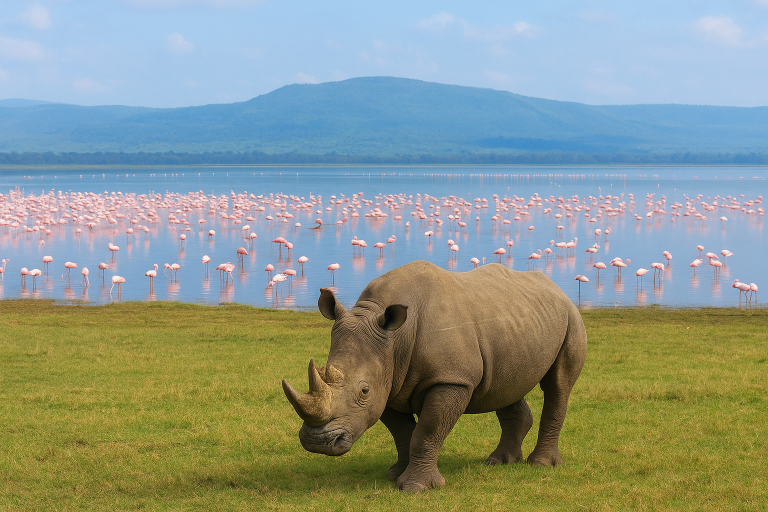
Lake Nakuru Safari Guide | Amazing Flamingos and Rhino
A Lake Nakuru safari adds a completely different landscape to a Kenya itinerary. Instead of the wide grasslands associated with the Masai Mara or the elephant-filled plains of Amboseli, Lake Nakuru combines a Rift Valley soda lake with wooded hills, open grassland, escarpments and important rhino habitat.
A Lake Nakuru safari adds a completely different landscape to a Kenya itinerary. Instead of the wide grasslands associated with the Masai Mara or the elephant-filled plains of Amboseli, Lake Nakuru combines a Rift Valley soda lake with wooded hills, open grassland, escarpments and important rhino habitat.
The lake is also one of Kenya’s best-known birding destinations. Flamingos have long been associated with Lake Nakuru, although their numbers and distribution can change considerably depending on water levels, food availability and wider environmental conditions.
For wildlife travellers, rhinos are another major attraction.
A Lake Nakuru safari can therefore work particularly well as part of a circuit rather than as an isolated destination. It can fit naturally between Nairobi, Lake Naivasha, Samburu, Amboseli and the Masai Mara depending on the route and number of days available.
This guide explains what to expect at Lake Nakuru, when to visit, where the flamingos are, why rhinos matter and how to combine the park with other Rift Valley lakes and Kenya’s major safari destinations.
Lake Nakuru Safari: Why Visit Lake Nakuru?
A Lake Nakuru safari combines rhino viewing, birdlife, dramatic Rift Valley scenery and relatively compact game-viewing areas into one accessible destination.
Lake Nakuru National Park sits within the Great Rift Valley and is surrounded by escarpments and higher ground.
The landscape includes:
- Lake Nakuru.
- Open grasslands.
- Acacia woodland.
- Rocky viewpoints.
- Forested areas.
- Seasonal wetlands.
- Cliffs and escarpments.
This diversity makes the park more than a lake destination.
You can spend part of a game drive searching for rhinos, move through woodland looking for leopards or giraffes, and later stop at a viewpoint overlooking the lake.
For travellers with limited time, this concentration of different habitats makes a Lake Nakuru safari particularly practical.
Lake Nakuru Safari: What Wildlife Can You See?
Lake Nakuru supports a wide range of wildlife, with rhinos, buffalo, Rothschild’s giraffes, lions, leopards and numerous bird species among the highlights.
Depending on conditions and luck, a game drive may produce sightings of:
- Black rhinos.
- White rhinos.
- Rothschild’s giraffes.
- Lions.
- Leopards.
- Buffalo.
- Zebras.
- Waterbuck.
- Warthogs.
- Baboons.
- Hyenas.
- Various antelope.
- Flamingos and other waterbirds.
The park’s relatively compact size can make it possible to explore several habitats during a single full-day game drive.
However, wildlife remains unpredictable.
Even in a productive park, there is no guarantee of seeing a particular species.
Lake Nakuru Safari: Why Are the Rhinos Important?
Rhino conservation is one of the strongest reasons to include Lake Nakuru on a Kenya safari because the park provides important habitat for both black and white rhinos.
Lake Nakuru has long been associated with rhino conservation.
The park’s protected environment provides habitat where visitors can potentially see both species.
Black and white rhinos have different feeding behaviours.
Black rhinos are primarily browsers, feeding on shrubs and other woody vegetation, while white rhinos are primarily grazers.
Seeing either species in the wild is a memorable experience.
A Lake Nakuru safari can therefore complement a visit to other Kenyan destinations where rhino viewing is also possible.
For travellers particularly interested in conservation, consider combining Nakuru with Laikipia and its important rhino conservation areas.
Lake Nakuru Safari: Are Flamingos Still There?
Flamingos remain an important part of Lake Nakuru’s identity, but their numbers can fluctuate and travellers should not expect the lake to always be covered in pink birds.
This is an important distinction.
Lake Nakuru became internationally famous for huge concentrations of flamingos.
However, water levels, changes in lake chemistry, food availability and environmental conditions influence where flamingos gather.
They may move between lakes within the Rift Valley.
Therefore, anyone searching for flamingos Kenya should think of the Rift Valley as a wider ecosystem rather than treating Lake Nakuru as a guaranteed flamingo location.
A good safari guide will understand current conditions and help set realistic expectations.
Flamingos Kenya: Why Do They Move?
Flamingos move in response to changing environmental conditions, particularly water levels, food availability and the suitability of different lakes.
The Rift Valley contains a chain of lakes with different ecological characteristics.
These include:
- Lake Nakuru.
- Lake Naivasha.
- Lake Elementaita.
- Lake Bogoria.
- Lake Baringo.
The conditions at each lake change over time.
When conditions at one location become less favourable, birds may move elsewhere.
This is why the number of flamingos at Lake Nakuru can vary substantially between visits.
For birdwatchers, this variability makes a wider Rift Valley itinerary more interesting.
Lake Nakuru Safari: The Rift Valley Lakes Circuit
The Rift Valley lakes circuit allows travellers to experience several contrasting lakes and ecosystems instead of relying on Lake Nakuru alone.
A broader circuit can include:
Lake Naivasha
Freshwater Lake Naivasha is known for hippos, birdlife and boat excursions.
Lake Elementaita
Elementaita is an important bird habitat and a quieter stop between Nakuru and Nairobi.
Lake Nakuru
Nakuru combines birdlife with major terrestrial wildlife, particularly rhinos.
Lake Bogoria
Bogoria is known for hot springs, dramatic scenery and its potential importance for flamingos.
Lake Baringo
Baringo offers freshwater scenery, birding and cultural experiences.
The exact route depends on your interests and available time.
Lake Nakuru Safari: Lake Nakuru vs Lake Naivasha
Lake Nakuru is generally stronger for terrestrial wildlife and rhino viewing, while Lake Naivasha is particularly attractive for boat trips, hippos and freshwater birdlife.
The two destinations complement each other well.
At Nakuru, focus on:
- Rhinos.
- Lions.
- Leopards.
- Giraffes.
- Buffalo.
- Birdlife.
At Naivasha, consider:
- Boat rides.
- Hippos.
- Waterbirds.
- Crescent Island walking experiences where available.
Combining both can create a more varied Rift Valley experience.
Lake Nakuru Safari: Lake Nakuru vs Lake Elementaita
Lake Elementaita is a smaller and quieter destination that can complement a Lake Nakuru safari with birding, scenic landscapes and a more relaxed atmosphere.
Elementaita is located between Nairobi and Nakuru.
This makes it convenient for travellers moving through the Rift Valley.
The lake is associated with birdlife and has important ecological value.
It may suit travellers who want to slow down rather than spend every day on long game drives.
Lake Nakuru Safari: Lake Bogoria
Lake Bogoria is best known for its dramatic hot springs, alkaline waters and birdlife, making it a distinctive addition to a Rift Valley lakes itinerary.
The landscape around Bogoria can feel much more rugged and arid than Nakuru.
Its geothermal activity adds another layer to the experience.
For travellers interested in geology, landscapes and birding, Bogoria can be an excellent addition.
However, adding northern Rift Valley lakes can increase driving time.
Route planning therefore matters.
Lake Nakuru Safari: Best Time to Visit
Lake Nakuru can be visited throughout the year, with dry periods often offering easier game viewing and wetter periods bringing greener scenery and productive birding conditions.
January and February
These months can offer generally favourable safari conditions.
Wildlife viewing can be productive, while the landscape may retain some greenery depending on recent rainfall.
March to May
The long rains can make the park lush.
Birdlife can be particularly interesting, but heavy rainfall may affect some roads.
June to October
The drier months are popular for game viewing.
Road conditions are often more predictable, and animals can become easier to locate.
November and December
The short rains can bring fresh vegetation and dramatic skies.
This period can appeal to travellers looking for greener scenery and potentially fewer visitors.
Lake Nakuru Safari: Best Time for Flamingos
There is no guaranteed month when Lake Nakuru will always have enormous flamingo concentrations because their distribution changes with environmental conditions.
This is why the phrase flamingos Kenya should not automatically mean “guaranteed flamingos at Nakuru.”
If flamingos are your primary reason for visiting, consider a broader Rift Valley itinerary.
Your safari operator can also check current ecological conditions when planning the trip.
For general wildlife, however, Nakuru remains worthwhile even when flamingo numbers are low.
Lake Nakuru Safari: How Many Days Do You Need?
One full day is usually enough for a useful Lake Nakuru safari, while two nights allow a more relaxed experience and easier connections with other Rift Valley destinations.
One-Day Visit
A day trip can include:
- Morning arrival.
- Game drive.
- Picnic or lodge lunch.
- Afternoon game drive.
- Departure.
This works particularly well for travellers staying in or near Nakuru.
Two-Night Stay
A two-night itinerary allows:
Day 1: Arrival and afternoon game drive.
Day 2: Full-day exploration.
Day 3: Morning game drive and onward travel.
This gives you more flexibility for wildlife viewing and photography.
Lake Nakuru Safari: Combining Nakuru With the Masai Mara
Lake Nakuru and the Masai Mara form one of Kenya’s most practical safari combinations because Nakuru provides rhinos and Rift Valley scenery before the Mara’s famous grasslands and predators.
A possible itinerary is:
Day 1: Nairobi.
Days 2–3: Lake Nakuru.
Days 4–7: Masai Mara.
This gives you:
- Rhino viewing.
- Rift Valley scenery.
- Big cats.
- Wildebeest.
- Giraffes.
- Elephants.
- Classic Mara landscapes.
Read our Masai Mara safari guide when planning the second part of your itinerary.
Lake Nakuru Safari: Combining Nakuru With Samburu
Adding Samburu to Lake Nakuru creates a varied Kenya itinerary that combines Rift Valley wildlife with northern Kenya’s Special Five.
A possible route is:
Days 1–2: Nairobi.
Days 3–4: Samburu.
Days 5–6: Lake Nakuru.
Days 7–9: Masai Mara.
This route provides very different ecosystems.
Samburu is known for:
- Grevy’s zebra.
- Reticulated giraffe.
- Gerenuk.
- Somali ostrich.
- Beisa oryx.
Nakuru adds:
- Rhinos.
- Rift Valley scenery.
- Birdlife.
The Mara then provides:
- Lions.
- Leopards.
- Cheetahs.
- Wildebeest.
Read our Samburu safari guide for more information about northern Kenya.
Lake Nakuru Safari: Combining Nakuru With Amboseli
Nakuru and Amboseli can work together for travellers who want both rhino viewing and famous elephant landscapes beneath Mount Kilimanjaro.
The contrast is excellent.
Amboseli is known for:
- Elephants.
- Kilimanjaro.
- Open plains.
- Wetlands.
Nakuru offers:
- Rhinos.
- Lake scenery.
- Forest.
- Birdlife.
A longer itinerary can connect:
Amboseli → Nairobi → Lake Nakuru → Masai Mara
or use internal flights to reduce driving where appropriate.
Our Amboseli safari guide explains the best timing for elephants and Kilimanjaro views.
Lake Nakuru Safari: Combining Nakuru With Laikipia
Laikipia and Lake Nakuru can create a strong conservation-focused itinerary for travellers interested in rhinos and different approaches to wildlife protection.
Nakuru provides an important protected national-park environment.
Laikipia offers a wider range of conservancy experiences, including selected opportunities for walking and night drives.
You can therefore compare two different conservation and tourism models within the same Kenya trip.
Our Laikipia safari guide covers the region’s conservancies and rhino experiences.
Lake Nakuru Safari: Where Should You Stay?
Your choice of accommodation should reflect whether Nakuru is a dedicated destination or a stop within a longer Kenya safari circuit.
Options can include:
- Lodges.
- Tented camps.
- Hotels in and around Nakuru.
- Private conservancy accommodation nearby.
For a dedicated safari experience, consider:
- Distance to park gates.
- Game-drive arrangements.
- Guide quality.
- Early breakfast availability.
- Vehicle access.
- Views.
- Meal plans.
If Nakuru is simply an overnight stop between destinations, convenience may matter more than luxury.
Lake Nakuru Safari: Is Nakuru Good for Families?
Lake Nakuru can be a practical family safari destination because of its relatively compact size, varied wildlife and easy combination with other Kenya attractions.
Children can learn about:
- Rhinos.
- Flamingos.
- Giraffes.
- Lions.
- Lake ecosystems.
- Rift Valley geology.
The park can also break up longer road journeys.
Instead of travelling directly between Nairobi and the Masai Mara, adding Nakuru creates a meaningful wildlife stop along the route.
Lake Nakuru Safari: Is It Good for Birdwatching?
Lake Nakuru is an excellent birding destination, with the lake and surrounding habitats supporting numerous waterbirds, raptors and terrestrial species.
Depending on conditions and season, birders may encounter:
- Flamingos.
- Pelicans.
- Storks.
- Herons.
- Egrets.
- Fish eagles.
- Raptors.
- Kingfishers.
- Migratory species.
Birding quality depends heavily on water conditions and seasonal movements.
A specialist guide can make a major difference if birds are a priority.
Lake Nakuru Safari: Photography Tips
Lake Nakuru provides opportunities for both wildlife and landscape photography, particularly around the lake, viewpoints and open grasslands.
Consider carrying:
- Telephoto lens.
- Wide-angle lens.
- Binoculars.
- Extra batteries.
- Memory cards.
- Lens cloth.
- Camera beanbag.
A wide lens is useful for landscape compositions incorporating the lake and escarpments.
A telephoto lens is better for rhinos and distant wildlife.
Morning and late afternoon light can provide the most attractive conditions.
Lake Nakuru Safari: Responsible Tourism
Responsible wildlife viewing protects the park’s animals and ensures that Lake Nakuru remains a valuable conservation area for future generations.
Visitors should:
- Keep a respectful distance.
- Stay on authorised roads.
- Avoid feeding animals.
- Never litter.
- Keep noise low.
- Follow guide instructions.
- Avoid crowding wildlife.
- Respect other safari vehicles.
When photographing rhinos, do not encourage drivers to approach animals too closely.
A good wildlife photograph is never worth disturbing an animal.
Lake Nakuru Safari: What Should You Pack?
Pack lightweight safari clothing, sun protection, binoculars and a warm layer for early mornings and cooler Rift Valley conditions.
Useful items include:
- Lightweight trousers.
- Long-sleeved shirts.
- T-shirts.
- Light jacket.
- Comfortable shoes.
- Hat.
- Sunglasses.
- Sunscreen.
- Binoculars.
- Camera.
- Extra batteries.
- Small daypack.
For a broader packing checklist, read our what to wear on safari guide.
Lake Nakuru Safari: Frequently Asked Questions
What is Lake Nakuru famous for?
Lake Nakuru is particularly known for rhinos, birdlife, flamingos and dramatic Rift Valley scenery.
Are there still flamingos at Lake Nakuru?
Flamingos can be found at Lake Nakuru, but their numbers fluctuate with water conditions, food availability and wider environmental changes.
Is Lake Nakuru good for rhinos?
Yes. The park is an important habitat for both black and white rhinos and is a popular destination for rhino viewing.
How many days do you need at Lake Nakuru?
One full day can provide a good introduction, while two nights allow a more relaxed safari and easier connections with other destinations.
What is the best time for a Lake Nakuru safari?
Nakuru can be visited year-round. Dry periods are popular for game viewing, while wet periods can produce greener landscapes and interesting birding.
Can Lake Nakuru be combined with the Masai Mara?
Yes. It is one of the most practical combinations for a Kenya safari.
Can I see lions at Lake Nakuru?
Yes. Lions are present in the park, although sightings cannot be guaranteed.
Can Lake Nakuru be combined with Samburu?
Yes. Nakuru and Samburu provide contrasting ecosystems and wildlife experiences.
Is Lake Nakuru worth visiting if there are few flamingos?
Yes. Rhino viewing, other wildlife, birdlife and Rift Valley scenery make the destination worthwhile even when flamingo numbers are lower.
Conclusion: Is a Lake Nakuru Safari Worth Adding to Your Kenya Itinerary?
A Lake Nakuru safari is one of the easiest ways to add rhino conservation, birdlife and dramatic Rift Valley scenery to a Kenya safari.
The lake itself is undoubtedly part of the attraction, but travellers should not judge Nakuru only by the number of flamingos present on a particular day.
Flamingo populations move according to ecological conditions, and the Rift Valley lakes function as a connected network of habitats.
The park’s rhinos are a major reason to visit.
Its lions, leopards, giraffes, buffalo and diverse birdlife provide additional reasons to spend time exploring beyond the lake shore.
For first-time visitors, Nakuru works particularly well between Nairobi and the Masai Mara.
For a longer itinerary, you can combine it with Samburu, Laikipia or Amboseli to create a much broader view of Kenya’s landscapes and conservation areas.
If you want to experience flamingos Kenya, rhinos and the wider Rift Valley lakes circuit without adding an unnecessarily complicated route, Lake Nakuru deserves serious consideration.
Odysseys From Africa can design a tailor-made Lake Nakuru safari around your preferred travel dates, wildlife priorities and wider Kenya itinerary.
Contact Odysseys From Africa
Planning a Lake Nakuru safari?
Our safari team can arrange:
- Lake Nakuru National Park safaris.
- Rhino-focused game drives.
- Rift Valley lakes itineraries.
- Birdwatching safaris.
- Flamingo-focused experiences.
- Private safari vehicles.
- Luxury and mid-range accommodation.
- Kenya multi-park safaris.
- Family safaris.
- Photography-focused itineraries.
- Kenya and Tanzania combinations.
- Tailor-made East African safaris.
Explore More
- Kenya Safaris
- Masai Mara Safari Guide
- Samburu Safari Guide
- Laikipia Safari Guide
- Amboseli Safari Guide
- What to Wear on Safari
Odysseys From Africa
Location: Arusha, Tanzania
Email: info@odysseys-from-africa.com
Phone (Kenya): +254 710 450 797
Phone (Tanzania): +255 652 810 255
Website: https://odysseys-from-africa.com/