
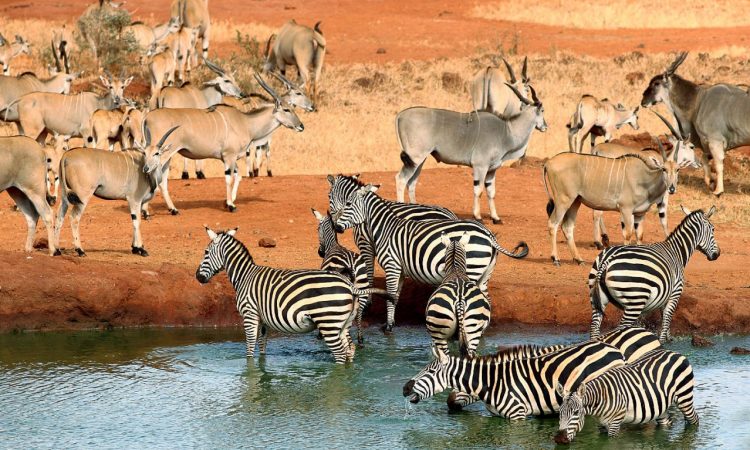
Tsavo East and West: Kenya’s Vast, Uncrowded Wilderness
A Tsavo safari offers a very different experience from the concentrated wildlife viewing of smaller parks. Tsavo East and Tsavo West together form one of Kenya’s largest protected landscapes, covering vast areas of wilderness where elephants, lions, buffalo, giraffes and numerous other species move through expansive and often rugged terrain.
Tsavo is also famous for its elephants.
The distinctive reddish appearance of some elephants is one of the park’s most recognisable sights. The colour comes from the red soil and dust that elephants coat themselves with rather than from a naturally red skin colour.
But Tsavo is about much more than elephants.
The two parks have different landscapes and experiences. Tsavo East is known for broad open spaces, the Galana River, red-soil landscapes and large elephant herds. Tsavo West is more mountainous and varied, with volcanic scenery, springs, lava flows, rocky hills and the Mzima Springs area.
Understanding the difference between the two is essential when planning a Tsavo safari.
Tsavo Safari: Why Visit Tsavo?
A Tsavo safari is ideal for travellers seeking huge wilderness landscapes, elephants, diverse scenery and a safari experience that can feel less concentrated than Kenya’s smaller parks.
Tsavo’s scale is one of its defining characteristics.
The landscape can change dramatically as you travel through the ecosystem.
You may encounter:
- Red-earth plains.
- Acacia woodland.
- Rocky hills.
- Lava formations.
- Rivers.
- Springs.
- Open grasslands.
- Dense bush.
- Volcanic landscapes.
The huge scale also means that wildlife may be more dispersed.
This can make sightings feel less predictable than in smaller parks, but it creates another type of safari experience.
Instead of moving rapidly between sightings, you can spend time travelling through a vast landscape and watching the environment change around you.
Tsavo Safari: Tsavo East vs West
Tsavo East is generally associated with vast open landscapes and red elephants, while Tsavo West offers more dramatic volcanic scenery, springs, hills and a greater variety of terrain.
Both parks are part of the wider Tsavo ecosystem, but they are not interchangeable.
Tsavo East
Best known for:
- Red elephants.
- Vast plains.
- Galana River.
- Yatta Plateau.
- Large elephant herds.
- Open wilderness.
- Lugard Falls area.
Tsavo West
Best known for:
- Mzima Springs.
- Volcanic landscapes.
- Chyulu Hills views in some areas.
- Lava flows.
- Rocky terrain.
- Rhino conservation areas.
- More varied scenery.
Choosing between them depends on what you want from your trip.
For many travellers, visiting both provides the strongest overall experience.
Tsavo Safari: Tsavo East National Park
Tsavo East is the larger and more open-feeling side of the Tsavo ecosystem, making it particularly attractive for travellers interested in elephants, expansive landscapes and classic African wilderness.
The park’s huge scale is immediately apparent.
Long drives can pass through open country where elephant herds appear against a backdrop of red soil and acacia.
The Galana River is another important feature.
Water sources can become especially significant during dry periods when wildlife concentrates around remaining water.
Tsavo East can therefore produce some memorable wildlife encounters.
Tsavo Safari: The Famous Red Elephants
The red elephants of Tsavo are actually African elephants covered in the park’s distinctive red dust and soil.
Tsavo’s soil contains strong reddish tones.
Elephants regularly dust themselves to:
- Protect the skin.
- Reduce irritation.
- Help with temperature regulation.
- Deal with insects.
- Maintain their skin.
When the dust coats their bodies, they take on the famous red appearance.
This is one of the most iconic photographic subjects on a Tsavo safari.
The contrast between a red elephant, green vegetation and blue sky can create striking images.
Red Elephants Kenya: Where Can You See Them?
Red elephants Kenya visitors usually associate with Tsavo East, where the red soil and elephant behaviour combine to create the characteristic appearance.
Elephants can also occur throughout the wider Tsavo ecosystem.
However, Tsavo East is particularly associated with the classic red-elephant image.
The best approach is not to chase individual elephants for photographs.
Instead, allow your guide to position the vehicle respectfully and give the animals space.
Tsavo Safari: Tsavo West National Park
Tsavo West offers a more varied and dramatic landscape, combining wildlife with volcanic terrain, springs, hills, lava flows and dense vegetation.
The park can feel very different from Tsavo East.
Instead of endless open plains, you may pass through:
- Rocky outcrops.
- Volcanic formations.
- Bushland.
- Hills.
- Lava fields.
- Springs.
- Forested areas.
This makes Tsavo West particularly attractive to photographers who want landscapes as well as wildlife.
Tsavo Safari: Mzima Springs
Mzima Springs is one of Tsavo West’s most famous attractions, where groundwater emerges from the surrounding volcanic landscape to create a clear-water oasis.
The springs are fed by water originating from the Chyulu Hills.
The water emerges through porous volcanic rock before forming pools and channels.
Visitors may encounter:
- Hippos.
- Crocodiles.
- Fish.
- Waterbirds.
A guided walk around the springs can provide a different perspective from a conventional game drive.
The experience also demonstrates how water shapes life in an otherwise dry landscape.
Tsavo Safari: Wildlife You Can See
A Tsavo safari can produce sightings of elephants, lions, buffalo, giraffes, zebras, hippos, crocodiles and numerous antelope species, although wildlife sightings are never guaranteed.
Potential sightings include:
- Elephants.
- Lions.
- Leopards.
- Buffalo.
- Giraffes.
- Zebras.
- Hippos.
- Crocodiles.
- Warthogs.
- Dik-diks.
- Gerenuks.
- Elands.
- Impalas.
- Waterbuck.
- Hyenas.
- Wild dogs in suitable areas.
Tsavo’s wildlife is adapted to a challenging environment.
Some species are easier to spot in open country, while others remain hidden in thicker vegetation.
Tsavo Safari: The Tsavo Lions
Tsavo is historically famous for its lions, making the park particularly interesting for travellers fascinated by the history and behaviour of African big cats.
The most famous story concerns the so-called man-eaters of Tsavo, associated with the construction of the Kenya-Uganda railway in the late nineteenth century.
The story has become part of Tsavo’s history and popular culture.
Modern Tsavo is, of course, a functioning wildlife ecosystem where lions play a normal ecological role.
Seeing a lion in the wild should be understood as a natural wildlife encounter rather than through the sensationalised history alone.
Tsavo Safari: The Landscape Is Part of the Experience
Tsavo’s enormous landscapes are one of the strongest reasons to visit, particularly for travellers who value wilderness and scenery as much as ticking species off a list.
The park can feel genuinely expansive.
You may drive for considerable distances without seeing another vehicle.
That sense of space is valuable.
It allows travellers to appreciate:
- Seasonal rivers.
- Grasslands.
- Bushland.
- Volcanic hills.
- Acacia woodland.
- Dry riverbeds.
- Open horizons.
For landscape photographers, Tsavo can be as rewarding as the wildlife.
Tsavo Safari: Yatta Plateau
The Yatta Plateau is one of Tsavo East’s most striking geological features and provides an impressive example of the region’s volcanic history.
The plateau stretches for hundreds of kilometres and is associated with ancient lava flows.
Its long, elevated form contrasts with the surrounding plains.
A knowledgeable guide can explain how volcanic activity helped shape the landscape.
This is one reason a Tsavo safari can appeal to travellers interested in geology as well as wildlife.
Tsavo Safari: Lugard Falls
Lugard Falls is a series of sculpted rocks and rapids along the Galana River, creating one of Tsavo East’s most distinctive landscape stops.
Despite the name, Lugard Falls is not a conventional waterfall.
The river moves through a narrow, rocky landscape shaped by erosion.
The formations create attractive photographic opportunities, particularly when water levels are suitable.
It is another example of how Tsavo’s rivers and geology interact.
Tsavo Safari: Best Time to Visit
Tsavo can be visited throughout the year, with dry periods generally making wildlife easier to locate while wetter months produce greener scenery and fresh vegetation.
June to October
The dry season is popular for wildlife viewing.
Animals may gather around reliable water sources.
The vegetation is also generally less dense.
January to February
These months can provide good safari conditions between major rainy periods.
The landscape can retain some greenery.
March to May
The long rains bring fresh vegetation.
Some roads can become challenging after heavy rainfall.
However, the green landscapes can be highly rewarding for photographers.
November to December
The short rains can transform the landscape.
Bird activity may increase, and the park can look dramatically greener.
Tsavo Safari: How Many Days Do You Need?
Two nights can provide a useful introduction to Tsavo, while four or more nights allow travellers to experience both East and West without rushing.
Two-Night Tsavo Safari
A simple itinerary could be:
Day 1: Enter Tsavo and afternoon game drive.
Day 2: Full-day game drive.
Day 3: Morning game drive and departure.
This works well for travellers combining Tsavo with the Kenyan coast.
Four-Night Tsavo Safari
A longer trip could include:
Days 1–2: Tsavo East.
Days 3–4: Tsavo West.
This provides more time to appreciate the different landscapes.
Tsavo Safari: Should You Visit East or West?
Choose Tsavo East for expansive wilderness and red elephants, while Tsavo West is the stronger choice for volcanic scenery, Mzima Springs and varied landscapes.
Choose Tsavo East if you prioritise:
- Elephants.
- Red soil.
- Open landscapes.
- Large wilderness.
- Galana River.
- Yatta Plateau.
Choose Tsavo West if you prioritise:
- Mzima Springs.
- Volcanic scenery.
- Rocky landscapes.
- Springs.
- More varied terrain.
- Rhino conservation.
If your schedule permits, visit both.
Tsavo Safari: Is Tsavo Good for Families?
Tsavo can be an excellent family destination for travellers who want a spacious safari environment, diverse wildlife and the option to combine wildlife with coastal holidays.
The park’s proximity to Kenya’s coast makes it particularly convenient.
Families staying in:
- Mombasa.
- Diani.
- Kilifi.
- Watamu.
can potentially combine a beach holiday with a safari.
Children can learn about:
- Elephants.
- Lions.
- Geology.
- Water systems.
- Conservation.
- African landscapes.
The right lodge or camp can also help tailor game drives to the family’s pace.
Tsavo Safari: Tsavo and the Kenyan Coast
Tsavo is one of the easiest major safari destinations to combine with Kenya’s Indian Ocean coast, creating a classic bush-and-beach itinerary.
A possible itinerary could be:
Days 1–3: Tsavo East.
Days 4–5: Tsavo West.
Days 6–9: Mombasa or Diani Beach.
This combination gives travellers:
- Wildlife.
- Wilderness.
- Elephants.
- Coastal scenery.
- Indian Ocean beaches.
For visitors arriving through Mombasa, Tsavo can be particularly convenient.
Tsavo Safari: Tsavo East vs Masai Mara
Tsavo and the Masai Mara offer very different safari experiences, with Tsavo emphasising wilderness scale and elephants while the Mara is particularly famous for big cats and open grassland.
The Masai Mara is known for:
- Lions.
- Leopards.
- Cheetahs.
- Wildebeest.
- Open plains.
- Migration.
Tsavo is known for:
- Elephants.
- Vast landscapes.
- Red soil.
- Volcanic terrain.
- Large protected areas.
You do not necessarily need to choose one.
A longer Kenya itinerary can include both.
Our Masai Mara safari guide explains how to plan time in the Mara.
Tsavo Safari: Tsavo vs Amboseli
Tsavo and Amboseli work well together because both are strong elephant destinations but offer dramatically different landscapes.
Amboseli is famous for:
- Large elephant herds.
- Mount Kilimanjaro.
- Open plains.
- Swamps and wetlands.
Tsavo offers:
- Red elephants.
- Vast wilderness.
- Bushland.
- Volcanic scenery.
- Rivers and springs.
Our Amboseli safari guide covers the park in more detail.
Tsavo Safari: Tsavo vs Laikipia
Tsavo offers a vast national-park wilderness, while Laikipia provides a more conservancy-focused experience with activities such as walking and selected night drives.
Laikipia can be particularly attractive to travellers interested in:
- Rhino conservation.
- Walking.
- African wild dogs.
- Private conservancies.
- Specialist guiding.
Tsavo is stronger for:
- Large landscapes.
- Elephants.
- Red soil.
- Wilderness scale.
- Bush-and-beach combinations.
Read our Laikipia safari guide for a detailed comparison of that region.
Tsavo Safari: Photography
Tsavo provides exceptional opportunities for elephant, wildlife and landscape photography, especially when the red soil creates strong contrast around animals.
A useful safari photography kit includes:
- Telephoto lens.
- Wide-angle lens.
- Extra batteries.
- Spare memory cards.
- Lens cloth.
- Binoculars.
- Beanbag or support.
For elephants, avoid getting too close.
A longer lens can allow you to capture intimate details without disturbing the herd.
For broader wildlife photography advice, read our big cat photography safari guide.
Tsavo Safari: What Should You Pack?
Pack lightweight clothing, sun protection, comfortable shoes and a warm layer because early morning and evening game drives can be cool.
Recommended items include:
- Lightweight trousers.
- Long-sleeved shirts.
- T-shirts.
- Fleece or light jacket.
- Comfortable walking shoes.
- Hat.
- Sunglasses.
- Sunscreen.
- Binoculars.
- Camera.
- Extra batteries.
- Reusable water bottle.
- Small daypack.
For more practical advice, read our what to wear on safari guide.
Tsavo Safari: Responsible Wildlife Viewing
Responsible behaviour helps protect Tsavo’s wildlife and preserves the wilderness qualities that make the park special.
Visitors should:
- Stay inside the vehicle where required.
- Keep a respectful distance from animals.
- Never feed wildlife.
- Avoid loud noises.
- Stay on authorised tracks.
- Follow guide instructions.
- Never litter.
- Avoid crowding sightings.
- Respect other safari vehicles.
The scale of Tsavo can make it feel untouched, but conservation requires constant effort.
Responsible tourism contributes to the continued protection of this important ecosystem.
Tsavo Safari: Frequently Asked Questions
What is Tsavo famous for?
Tsavo is famous for its enormous wilderness, elephants, red-soil landscapes, lions, diverse wildlife and dramatic scenery.
What are the red elephants of Tsavo?
The red elephants are African elephants whose bodies become coated with Tsavo’s distinctive red soil and dust.
Is Tsavo East or West better?
Neither is universally better. Tsavo East is stronger for vast landscapes and red elephants, while Tsavo West offers volcanic scenery, Mzima Springs and varied terrain.
Can I visit Tsavo East and West on the same safari?
Yes. A longer itinerary can combine both parks.
How many days should I spend in Tsavo?
Two nights can provide a good introduction. Four or more nights are preferable if you want to explore both East and West.
Can you see lions in Tsavo?
Yes. Tsavo supports lions, although sightings are never guaranteed.
Is Tsavo good for elephants?
Yes. Elephants are one of Tsavo’s major attractions, particularly the famous red elephants of Tsavo East.
Can Tsavo be combined with Mombasa?
Yes. Tsavo is particularly well suited to a bush-and-beach itinerary with Mombasa or Diani.
Is Tsavo good for families?
Yes. Its wildlife, landscapes and proximity to the coast make it a practical option for family safaris.
Is Tsavo crowded?
Tsavo is enormous, so some areas can feel significantly less concentrated than smaller, heavily visited safari destinations. Visitor density varies by location, season and time of day.
Conclusion: Is a Tsavo Safari Worth It?
A Tsavo safari is one of Kenya’s best choices for travellers who want scale, wilderness and elephants.
Tsavo East and Tsavo West should not be treated as identical destinations.
Tsavo East is the place to look for the famous red elephants, enormous landscapes, the Galana River and the Yatta Plateau.
Tsavo West offers a more varied environment, with volcanic scenery, Mzima Springs, rocky terrain and a different style of game viewing.
Together, they create a remarkably diverse safari experience.
Tsavo is particularly well suited to travellers who want to combine safari with the Kenyan coast. A few nights among elephants and red-earth landscapes followed by time on the Indian Ocean can create a balanced Kenya holiday.
It can also complement destinations such as the Masai Mara, Amboseli, Lake Nakuru and Laikipia.
If your priority is a Tsavo safari with elephants, wilderness and fewer concentrated wildlife-viewing areas, Tsavo deserves a place on your Kenya itinerary.
Odysseys From Africa can build a tailor-made Tsavo safari around your preferred parks, accommodation, travel dates and wider Kenya itinerary.
Contact Odysseys From Africa
Planning a Tsavo safari?
Our safari team can arrange:
- Tsavo East safaris.
- Tsavo West safaris.
- Combined Tsavo East and West itineraries.
- Elephant-focused safaris.
- Wildlife photography trips.
- Private game drives.
- Family safaris.
- Luxury and mid-range camps.
- Tsavo and Mombasa combinations.
- Tsavo and Diani Beach holidays.
- Kenya multi-park safaris.
- Kenya and Tanzania combinations.
- Tailor-made East African itineraries.
Explore More
- Kenya Safaris
- Masai Mara Safari Guide
- Amboseli Safari Guide
- Laikipia Safari Guide
- Lake Nakuru Safari Guide
- What to Wear on Safari
Odysseys From Africa
Location: Arusha, Tanzania
Email: info@odysseys-from-africa.com
Phone (Kenya): +254 710 450 797
Phone (Tanzania): +255 652 810 255
Website: https://odysseys-from-africa.com/